Showing posts with label horses. Show all posts

Saturday, October 6, 2012

Trailer Tales: Balancing Evil with Big-Hearted Behavior

As you may imagine, my reading is frequently filled with the unconscionable things people do to animals. Here are a few I’ve come across since Wednesday:

1. To desensitize the horse who doesn’t like having his/her ears touched, some folks twist and pull the horse’s ears, sometimes to the point of breaking the cartilage. It’s an Old West version of “If you don’t stop crying, I’ll give you something to cry about.” A blogger believed this had been done to the horse she’d recently adopted and is now rehabilitating.

2. To counter the horse who fights having a bit in her/his mouth, some folks turn the horse’s head to the side and tie the tight rein to a stirrup (the one connected to the saddle on the horse’s back). They may leave the horse immobilized in that position for hours. One blogger suggests: “Before you think of doing this to your horse, tie the top of your head to your knee with a shortened length of rope and see what you learn!”

3. To retire a breeder dog who’s no longer a top producer, one option is to dump her along a road. One such dog was discovered near San Francisco this week—thrown from a car, bloody, emaciated, still swollen from her recent (and final) litter. Thankfully, a Good Samaritan found her and took her to BadRap Barn.

My ability to sift and steel through these stories fluctuates. I don’t share many of them on Lull because I want to spare you the disgust and hopelessness and rage and sick, sick feelings these atrocities bring out in me. And yet, I believe we have to be aware of some (though not all) of these situations if we want to change the world. We need to know the details in order to prevent them from happening in the future. We need to know our enemies and how they operate.

“People have forgotten this truth,” the fox said. “But you mustn’t forget it. You become responsible forever for what you’ve tamed.”
—from The Little Prince, by Antoine de Saint-Exupéry

Are you still reading? I hope so, because we’re finally getting to the good stuff—the other side of the balance sheet. The two positive stories I heard or read this week each involve a horse trailer…

Anna Blake, a horse trainer, wrote about a client of hers who was moving to a new state. The first piece of good news is that, unlike so many people who get rid of their animals before moving (or even before going on vacation), the client was taking her critters along. What’s more, the client insisted on riding in the trailer with them: three draft horses, two donkeys, and a parrot—each a rescue, each with some kind of challenge. The woman packed a cooler, a sleeping bag, and a chaise longue into the trailer and settled in for the 26-hour ride. She would spend that time calming her companions and watching for signs of discomfort or illness.

I love her deep concern and care for her charges. This warm-and-fuzzy story alone was enough to buoy my emotions over the evils roiling within my reading reach. But last night I heard about a more impressive animal advocate.

A woman (a friend of a friend) attended an auction in Pennsylvania (I don’t know which one; my friend was lean on details) with trailer in tow because she fully expected to purchase a horse. She stayed for the whole auction, but by its end, she didn’t hold the winning bid for anyone. She would be going home to her 700+-acre farm with an empty trailer.

She returned to her vehicle only to find FOUR creatures packed into her trailer! Someone apparently hadn’t sold them and, not wanting to keep the horses any longer, dumped them in the least guilt-inducing way that came to mind: Leave the animals in someone else’s trailer—make the animals someone else’s problem.

Fortunately for the ponies, the friend of my friend is not the abandoning kind. She shifted her mindset from going home empty-trailered to planning how to introduce her herd at home to these four new horses—horses who might otherwise have ended up taking that long, painful journey to the abattoirs South of the Border.

Some folks simply don’t know how to be good; they need role models to emulate. Other folks? Well, they bewilder me. But I’ll keep searching for a way in to their deeply hidden reserve of emotional intelligence.

Meanwhile, let’s circulate these trailer tales. They’re spirit-lifting, plus they might prompt others to tap into their own goodness the next time an opportunity arises.

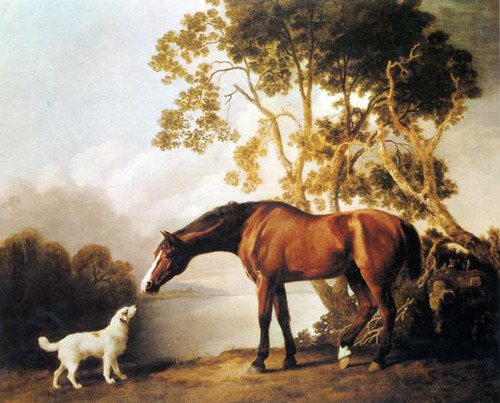
[Paintings by George Stubbs.]


Thursday, September 27, 2012

Learning A New Language

As commerce and communities continue struggling toward a global mashup, it seems critical that we comprehend more than one language. Considering the latest U.S. demographics, Spanish would be the sensible choice for Americans who now speak only English. For job-seekers, Chinese or Arabic could improve your employment chances. I, on the other hand, have been busy lately learning a somewhat obscure language: horse.

“Do you even HAVE a horse?” you may be thinking. “Are you planning on GETTING one?”

No. And No. But logic and practicality don’t always rule my decisions.

In fairness, though, I have a few good reasons: 1) Learning anything new keeps one’s brain functioning properly, 2) I AM residing in the horse capital of the world, plus 3) I’m taking riding lessons, so it behooves me to communicate well with the powerful creatures who could easily (albeit unintentionally) maim me.

Anyway, I’m going to give it my best shot. Mr. Ed made it so easy for Wilbur Post. (If Rosetta Stone would only add animal languages to its roster, I’d be a loyal customer!) I’ll let you know how it goes…

[Photo of Rousing Sermon by John Sommers II for Reuters.]

Monday, September 3, 2012

Calling Out Animal Cruelty: Is It Interference or Intervention?

Over coffee this summer, a friend expressed her anger at some nameless person who accused her neighbor of animal cruelty. Animal-control officials visited this neighbor and told her the anonymous caller had reported seeing her dog limping slowly and with great difficulty on a walk. The officials needed to determine why and to what extent the dog’s mobility was impaired.

I understood my friend’s ire on behalf of her neighbor. The truth was that the dog was ancient and suffering from arthritis. The dog’s guardian had not been able to make the necessary end-of-life decision she knew it was time for. Yes, the dog was in pain—which the woman and her vet were trying to manage—but the cause was not what the anonymous caller had imagined.

I told my friend what I’d heard the previous month at a public forum regarding the Kentucky Livestock Care Standards Commission. A spokesperson for the Kentucky Horse Council derided every concerned citizen who had ever lodged complaints against horse businesses. She said outsiders were uninformed about equine care and they reported things like deep spring mud and summer fly masks as neglect and cruelty, respectively. In the context of the forum, she was drawing a line between farms/the equine industry and animal welfare advocates. Like my friend’s neighbor, this representative for horses (well, really for the horse industry) viewed outsiders as annoyances—meddlers who stirred up trouble where there wasn’t any.

I can sympathize with both women. It’s frustrating and hurtful to be accused of something you didn’t do. It’s time-consuming to deal with such issues and to set the record straight.

But I think about a comment I read last year on the Web. The commenter described a dog tied up in an Alabama backyard—a dog who had no shelter, no exercise, no freedom of movement, no food, and no water. The writer meant to vilify the dog’s “guardian” for neglect, but in the end, readers learned that the writer witnessed this scene for an entire YEAR on his/her way to work and not once reported it to authorities. The dog starved to death, its body left in the backyard to decompose.

Now I’d like to ask Ms. Kentucky Horse Council Spokesperson: Is it better that citizens say nothing about what they see?

Sometimes … no, actually too frequently citizens report neglect or cruelty only to find that authorities do nothing. Cricket (who is pictured on the right of the photo with her new friends, one of whom is wearing a fly mask, at Catskill Animal Sanctuary; her rescue last year was reported on Lull) was once chained to a tree—with no accessible food or water in sight—on the farm she shared with other ill-cared-for animals. Passersby noticed first, then animal-rescue folks got involved, and though all these caring people jumped through every legal hoop required, the authorities took ONE YEAR before acting on the complaints. Turns out Cricket’s “guardian” was the very same hoarder who had surrendered animals to Catskill Animal Sanctuary 10 years earlier! New farm, new critters, same psycho. (My apologies to hoarders for my harsh language. I realize hoarding is an illness. But I also know that without medical attention, you will not change.)

Again, Ms. Kentucky Horse Council Spokesperson: When a horse is tethered to a tree by a short chain that not only prohibits her movements but bores into her flesh, should nonhorsepeople keep their mouths shut because they know so little about horses? Should concerned citizens refrain from getting involved in case they’ve misinterpreted the situation?

I think not. Clearly, we need authorities (legislators, animal-control agencies, police, judges, lawyers) who are better informed about animal welfare, who take it seriously, and who take action when it’s required. But we also need more “meddlers” who have the courage to speak out for those who cannot. Some of their reports may be off-base (as was the case with the geriatric pooch described above, though the woman said the event nudged her into making the right decision for her dog); but others will be valid cases demanding immediate involvement. It’s possible that behind the neglected animal is also a neglected senior or child. It’s also possible that behind a neglected animal are people in dire circumstances who could use assistance themselves. Or maybe, as in the case of the Pit Bull guardian I yelled at last year, the person is simply uninformed/misinformed about the care of the animal.

Sometimes intervention IS interference. But in the long run, we can tolerate it, can’t we? Let’s let the meddlers speak* and let’s hear what they have to say. Let’s SEE what’s happening around us—notice the vulnerable amongst us and have the backbone to speak out on their behalf.

* Please, oh puhleeze check out the story of Mr. Chips at The Literary Horse, in which Mr. Chips discovers bliss and attracts the Long Arm of the Law. But choose carefully where you read this tale: Laughter is guaranteed. (In fact, I encourage you to read every Mr. Chips tale in the series.)

[Photo of 17-year-old pooch taken in Montana by Nancy LeVine and included in her book, Senior Dogs Across America.]

Sunday, August 26, 2012

Meet Mr. Personality


Here’s another horse after my own heart:

Pictured (sitting) is Taffy, whose rider says he’s the laziest horse in the world. I prefer to think he hears a different drummer.

Watch his sweet video, “The Wonderful World of Taffy,” on YouTube.

Saturday, August 25, 2012

Groupon Wants My Feedback


Like thousands of other Americans, I have taken advantage of some of the discounts offered by Groupon. After my most recent deal, Groupon e-mailed me a “survey” about my experience—a private trail ride on horseback.

I wonder if the survey tactic is new for Groupon. They certainly didn’t ask me how I felt about the piece-of-crap keyboard I bought through them last spring. Anyway, I was happy to oblige.

The trouble was the structure of the survey. It allowed me to choose only one of two options, with no provision for comments or explanation: 1) I enjoyed ________ Stables and would recommend it to others, or 2) I did not enjoy ________ Stables and would not recommend it to others. Though this would seem to be the easiest kind of decision to make—as it would have been had I been asked about that useless keyboard—in this particular case, it was not.

The trail ride (actually, there was no trail; we just meandered through fields of wildflowers and butterflies) was fine. We were treated well and received what we were promised. For animal lovers, the place was a dream: 70 horses (including yearlings and seniors), a pony, a donkey, a variety of dogs from pug puppies to an ancient mastiff, cats, a rabbit, and a free-range pig.

However, for animal lovers, the place was also a nightmare: One dog was tethered to a tree, the cats were bony with opossum-like tails, tumors covered the large dogs, the pig’s stomach dragged the ground, and the rabbit—after surviving life at a research facility—seemed desperate to escape its small, filthy cage.

This father-daughter operation includes riding lessons, horse breeding, dog breeding, competitions—and no help. We learned that half of this business duo was out of commission, struck by cancer. The daughter, while performing caregiving duties for her father, managed the farm by herself. Times were tough and getting tougher.

So, did the daughter partner with Groupon in hopes of garnering repeat business? Or was she simply going for an influx of cash? Her farm sorely needs both scenarios, which is why I didn’t want to choose “No” on the Groupon survey.

On the other hand, how can I recommend a business where animals are not given proper vet care, many animals have to forage for their own food and water, and breeding principles are hardly recognized? Sadly, these issues probably aren’t the result of the father-daughter’s recent misfortunes. More likely they’re the result of a faulty philosophy about animal welfare. Worse, I suspect this farm isn’t an anomaly; there are hundreds, maybe thousands more like it across the country.

Had Groupon devised an e-mail survey with more options—for instance, a series of value statements that rated my experience—I might have been able to give the desired feedback. As it was, though, I chose the only other option left: I deleted it.

[Painting of horse by Gustave Caillebotte; painting of pig by Stephen Filarsky.]


Friday, August 24, 2012

The (Equine) Reading Life

Here’s a horse after my own heart:


This is Shana, whose guardian is equine coach Nicole Birkholzer. In a post on her Mindful Connections blog, Birkholzer asks whether horses are studious. Take a peek at the other horse pictured and you’ll have no trouble answering the question.

Friday, July 13, 2012

My Friday the 13th Lens

I’m not genuinely superstitious, but I do love Friday the 13ths. I feel especially motivated on these quirky days to rise above life’s disappointments and unfortunate circumstances and see only loveliness in the world.

On this last Friday the 13th of 2012, join me in contemplating this photograph of one of Everton Wright’s Walking Drawings. What better combination than art, animals, and beach?


Sunday, June 10, 2012

Dreams DO Come True

Most of us have dreams, but only a few of us get to see them come true. Yesterday, Phyllis Wyeth watched a horse she believed in spring her dreams out of her imagination and onto the Belmont Stakes finish line while thousands watched.

Thank you, Union Rags. You’ve rekindled hope for the rest of us.

[Photo by Mark Lennihan.]

Wednesday, May 23, 2012

A Mother’s Patience

In the last week I’ve read a memoir by an author whose mother physically abused him during his childhood. I watched a documentary about a television titan whose mother abused him verbally and emotionally throughout his life. You can imagine my relief to see this model of motherhood:


To view the bold colt a little later in life, please visit Mustang Saga to see the companion photo.

I guess some things in life don’t change.

Saturday, May 5, 2012

Grab a Hat and a Drink

Today marks the 138th anniversary of the Run for the Roses, a celebration that typically includes horses, hats, and mint juleps.

As you already know, I don’t watch races. And I discovered this morning that I suffer from a condition known as PPS: Pretty Pony Syndrome—meaning that if I were a betting person, which I’m not, I’d be swayed by the aesthetics of the horses. In today’s lineup, I’m particularly drawn to Hansen and Creative Cause.

In case you overdo it on the juleps this afternoon, here are a couple of sobering facts about the racing industry:
1. 750 horses die on U.S. racecourses each year.
(Would we allow a stat like that to exist for professional ball players in this country?)
2. More than 10,000 U.S. Thoroughbreds are shipped for slaughter each year.
(That’s just the Thoroughbreds, mind you. There are plenty of other breeds headed for slaughter each day.)

Sorry to be the killjoy, but if you’re watching the Derby, you need to know what you’re supporting.

For previous (mostly happier) posts about the Kentucky Derby, see “Dressing for Derby Day”—which includes info on hats and mint julep recipes, “Derby Day Is Here,” “WordGazing: Derby Tip for Grammarians,” “137th Derby Follow-Up,” and “May Day, May Day!

[Top pic: Amber, owned by Fox’s Biscuits, wears a Stephen Jones hat at Royal Ascot, Britain’s historic Thoroughbred racecourse.]

Wednesday, May 2, 2012

Hangin’ with the 1%

Sorry for my recent absence. I’ve no excuse, really. I was simply distracted by dogs and ponies and kettle corn.

The Bluegrass annually hosts a Really Big Show for eventing enthusiasts. (For those of you outside the equine sports community, “eventing” is an equine / equestrian triathlon combining dressage, jumping, and cross-country.) This particular contest—the Rolex Three-Day Event—is fiercely competitive and demands the utmost skill and athleticism from its participants, both equine and human. It is also dangerous and has taken the lives of horses and riders in the past.

At this point, you may well wonder why I’d watch such an event. I didn’t. I watched some world-class, gorgeous horses warm up before competing, but that was it. And that was enough. The rest of the time I served as a volunteer for the local humane society, walking a homeless dog through the crowds and telling everyone I could that she needed a home.

I met some great people from around the globe and heard oodles of rescue stories about both dogs and ponies. I also heard tales from the Dark Side—the cruel and unjustifiable things people do to animals because…

(I don’t know how to finish that last sentence, but I’m working on it because I want to fix it/stop it/prevent it.)

For four hours on Thursday and four hours on Friday, “Peachy” (or Peaches as I more often called her) and I walked the grounds. It was a dog-friendly event, so she met lots of elite dogs and their people. She also met vendors (her faves, of course, were hawking fried fair foods) and police officers (she displayed more respect for the mounted variety), horses and equestrians. She never uttered a sound and she never passed up a potentially edible item without first tasting it (peppers, bananas, tomatoes, broccoli, a frog*—all was fair game). When we rested beneath shady trees together, she always ended up in my lap, nuzzling her snout against my face.

As my shift ended on Friday, I considered it a personal failing that she hadn’t yet been adopted. A couple of other dogs snagged new homes, but not Peaches. There had been plenty of interest in her, but I hadn’t closed the deal with anyone.

Some people would initially try to ward me off by saying they lived far away. “I’m from California (or Colorado or Florida). Otherwise…” But I never waited for them to finish. As soon as they named their state, I shot back with “That’s not an obstacle. I’ll personally drive Peachy to wherever you live.” Yes, I realize now that they were actually attempting to say No to me in a way that 1) Wouldn’t offend me, and 2) Let them off the hook for what they considered good reason. I just wasn’t very reasonable. And frankly, I looked forward to a road trip.

I was hot, my feet hurt, and I couldn’t bear to think of Peachy reduced to living in the shelter again—where she’d been for many months because she’s a neurotic mess while there (bloodies her paws trying to claw her way out of the cage, can’t calm down long enough for any potential adopters to get a good look at her) and nobody wants to adopt a neurotic mess.

Except one woman, who I’m pretty sure had some neuroses of her own. I should have been thrilled over her attraction to Peaches, but I wasn’t. I dreaded she would be the ONLY hope. My concern hinged largely on a single question the woman asked me repeatedly: “Can you guarantee she won’t run away?” She explained she planned to let Peachy roam her large farm with her other rescued dogs. I asked her how she managed to get the other dogs to stay on the farm. She said they simply followed her around. I said I couldn’t guarantee anything. I believed she’d need to work patiently with Peaches to educate the dog about her new home and boundaries.

I went home. Saturday passed. Sunday morning I returned to the park for my shift working Doggie Daycare (basically a boarding service for the dogs of the 1%). Several more dogs had been adopted since Friday. And Peachy?


“Yeah, we think she’ll get a home today,” said one of the humane society employees.

I cringed. “Is it the woman?”

“No. You’ll like these people.”

I couldn’t imagine who would meet the standards I’d suddenly set for my Peaches. There had been one family I wanted to belong to myself, but they clearly had enough animals and children and stuff going on already. I didn’t even try to push Peaches on them, but I enjoyed chatting with them whenever I ran into them.

Halfway through my shift as prison warden to a couple of elite dogs from Hell, I noticed my dream family standing outside the Doggie Daycare tent. I stepped outside to say Hey, but was rendered speechless and motionless when I realized why they were there: They had decided to adopt Peaches.

I couldn’t believe Peachy’s good fortune. I thanked the young father profusely and said I could just hug him. (I am NOT a hugger.) He hugged me. I’m sorry now that I didn’t get a pic of the entire dreamy blended family. When my shift ended, I celebrated by buying a bag of kettle corn and blissfully munching on it as I strolled around the park in a daze.

On Monday morning, I worried about Peachy. I sent her telepathic messages: “PleaseBeGood. PleaseBeGood. Don’t steal anyone’s food, leave the horse pies alone, cuddle with everybody. Do NOT make that family resent your adoption—they are the best home any dog could hope for. PleaseBeGood.”

On Monday afternoon, I received a follow-up e-mail about the event from the humane society. In addition to raising an impressive amount of money through the Doggie Daycare, the merchandise tent, and donations collected by the shelter dogs (they wore little coats with big pockets in which passersby would slip $10, $5, or $1 bills), eleven pooches shook free from their homeless labels and left the Rolex event with their new families.

I know what some of you are thinking: “Eleven? What’s eleven next to the millions still waiting for homes?”

You’re right, of course. Eleven is nothing.

But for Peachy, and for each of her ten canine pals, it’s everything.

* The frog incident was not on my watch, thank goodness.
[Pics of Peaches snapped in haste by yours truly; photo of Rolex second-place winner Allison Springer and her horse, Arthur (who won the coveted award for Best Conditioned Horse), by Nancy Jaffer.]

Tuesday, April 24, 2012

BOOKreMARKS: Did You Know…?

My brain is aflutter with what I’ve read this week and I wanted to share with you a few things I’ve learned.

1. Snails have more than 2,000 tiny teeth. Some species shoot the object of their affections with a love dart. Really.
from The Sound of a Wild Snail Eating by Elisabeth Tova Bailey

2. After the Korean War, the Marines schemed to make money and fame by breeding an equine war heroine, Reckless, with a stallion of royal bloodlines. The military PR folks expected her offspring to win a Kentucky Derby. Problem was that Reckless fell for a bronco instead of the blueblood.
from Chicken Soup For The Horse Lover’s Soul: Inspirational Stories About Horses and the People Who Love Them

3. I often wondered how humans so quickly decimated large populations of elephants and rhinos in Africa. Here’s one reason: In the 1970s and ’80s, poachers used machine guns. Talk about having an edge
from Bulu: African Wonder Dog by Dick Houston

4. When geriatric canines start showing signs of anxiety and behavioral changes/problems, it’s time for a vet visit. Typically, the anxiety indicates a health issue of some sort—one that your pooch is sometimes aware of long before you or technology can detect it. You can control the anxiety through behavior modification training and medication, but you need to monitor and treat the more critical source of the behavioral changes—that is, the tumor or cancer or whatever physiological ailment is taking root. (I suspect the same is true for cats.)
from The Dog Who Loved Too Much: Tales, Treatments, and the Psychology of Dogs by Nicholas Dodman


“Reading without reflecting is like eating without digesting.”
—Edmund Burke


5. If someone you know—especially an elderly someone—shows signs of confusion about recognizing everyday objects or faces or places, don’t immediately chalk it up to a faulty memory or poor vision or senility. It may be a fancy-named neurological glitch. Encourage your friend or loved one to see a neurologist.
from The Mind’s Eye by Oliver Sacks

6. Some horses run better on turf than on dirt. No surprise there. But I AM surprised that at one point at Santa Anita, the turf racetrack crosses paths with the dirt track. That is, it switches from turf to dirt and back again to turf. If I were doing the racing, I’d find that unsettling—as did one of Smiley’s horses. Not only can it impede the horse’s ability to win, it poses potential physical danger to the horse.
from A Year at the Races: Reflections on Horses, Humans, Love, Money, and Luck by Jane Smiley

7. Jill Abramson, making history as executive editor of the New York Times, once drove the getaway van in a kidnapping. Well, more of a rescue, actually. She was assisting a friend in removing a dog from the house of the woman’s abusive ex-boyfriend. You gotta love someone who has superhero tendencies.
from The Puppy Diaries: Raising a Dog Named Scout by Jill Abramson

[Art by Gyula Benczúr.]

Saturday, April 21, 2012

You’re Never Too Old to Start a New Life

In addition to being National Poetry Month, it’s also Prevention of Cruelty to Animals Month. Sadly, we need far more than a month to address this subject. But as a cheerful nod to the occasion, I want to introduce you to Lady Jane.


Lady Jane is a 20+-year-old mare who spent her first couple of decades with a woman known for chronically neglecting the animals in her care. Last month, Catskill Animal Sanctuary persuaded the woman to surrender two of her many charges, including Lady Jane.

Turns out, the mare was pregnant. Despite her poor condition, she gave birth to a healthy foal this week—a first for CAS and the last for the mare.


From now on, Lady Jane can look forward to some regularity in her life—regular feedings of nutritious meals, regular grooming and vet care, regular time spent with other horses in a safe environment, and regular affection from humans. And little Simon will (we hope) remain blissfully unaware of the kind of neglect his mother experienced.


[See more pics on CAS’s photostream.]

Wednesday, April 18, 2012

BOOKreMARKS: My Pseudoselection Process

My recent trip to the library added an abundance of animal books—some that you may question—to my Current Reading Lineup list. Allow me to explain.

I’ve acquired a weird sense of urgency about borrowing books. Once inside the library, I beeline to the animals and new-arrivals sections. As I scan the spines, an afflicted part of my brain says, “Take it now. You may never see it at this location again.”

This is true. Books are constantly shuffled between the Central Library and its five or six branches. But then my rational brain steps in to advise: “You could always plan ahead and request that a particular title be held for you at the branch of your choosing.”

This is also true, yet tricky. Lots of variables play into the timing: when (and if) the last borrower actually returns the book, whether the book’s condition is deemed acceptable for continued borrowing, how long the book is in transit from one library to another. And if I request more than one book, how many trips to the library must I make to retrieve them all? In the end, I panic and defer to my affliction. If I see something that interests me, I take it.

A few of my selections this month could have been more informed. For instance, I had The Puppy Diaries confused with a different book about raising a guide-dog pooch. The Bill Henderson (founder of Pushcart Press/Prize) memoir contains a struggle with religion, a topic I’m not interested in right now. And then, of course, it apparently slipped my mind when I grabbed the horse book how prominently religion figures into the Chicken Soup series.

But I’m reading all the books anyway and, so far, no regrets. Henderson has helped me solidify my philosophy about dog companionship; Abramson has driven home the notion that a high IQ, successful career, and A-list friends aren’t enough to make someone a great pet guardian; and the Chicken Soup collection reminds me of how many untold tales are out there awaiting their debut in print.

My pseudoselection process may not have presented me with the books I expected, but I’ll be richer for having read them.

[Art by Van Gogh.]

Tuesday, April 10, 2012

A Remedy for Loneliness

It’s National Poetry Month again. Wanted to share this Jessie Haas poem that she crafted from a true story. (For me, the richer experience is imagining the poem rather than the poem itself.)

Company for Breakfast
Ashton Timson lived alone, up there on the hill.
Bred good work stock.
One year a mare died on him.
Ashton raised her colt on a bottle.
It did all right.
Some folks came up to visit one morning.
Near the house they heard talking.
“Ashton must have company!”
They knocked
He came to the door.
Behind him in the kitchen,
Was that good-sized workhorse colt.
“I was lonely, and so was he,” says Ashton,
“So I asked him in to breakfast.”

1940s, Williamsville, Vermont

—from Hoofprints, by Jessie Haas


[Pic is from America’s Horse Daily, which warns “Television is not recommended for foals.”]

Tuesday, March 20, 2012

Just Breathe

I started the day by reading a book I’ve really enjoyed so far, until I got to this passage:

“Now, don’t fall in love with it. When the foal is born, don’t pet it or even name it. You’re going to sell it as a yearling. Don’t get attached. Think of this mare as your factory.”
—Eddie Gregson

Think of this mare as your factory? Well, you can imagine where my mind started to travel after those words: foal factories, puppy mills, Apple in China, capitalism, greed, ethical boundaries, sociopaths… I stopped reading, started ranting (on paper), then decided to spare you my thoughts.

Step down from the soapbox, I commanded my crazed self, and breathe. It’s the first day of Spring. Is this any way to start the season?

No, it isn’t. (Inhale.) Besides, company is coming. (Exhale.)

Whew! I feel better already. My oldest friend (she’s not old, the friendship is) is due here tomorrow and I can hardly wait.


“My friends are my estate.”
—Emily Dickinson


Thursday, February 16, 2012

Atlantic City Horse-Diving Idea Tanks

From the 1920s to 1978, horse-diving acts were the main attraction at Steel Pier in Atlantic City. They were revived for a couple of months in 1993 by new owners of the pier, but abandoned after protests by animal rights groups.

Horse diving got its start in the late 1800s with William “Doc” Carver, a former performer in Buffalo Bill Cody’s Wild West Show. The act consists of a horse and rider diving from a 40- to 60-foot height into a 10- to 12-foot deep tank of water. Carver’s act became an entertainment staple at Steel Pier in the 1920s; it also spawned similar acts around the world, a memoir from one of the divers, a Disney film, and a Broadway musical.

As Steel Pier undergoes a multimillion renovation in the New Millennium, its owners (the same owners who closed the act in 1993) want to resurrect the nostalgic equine act. Naturally, animal welfare groups cried foul.

I signed a petition against the decision recently and was about to ask you to do the same. But good news arrived today instead! The owners have decided to abandon their idea. But not because of the outcry.

“We just felt that since Atlantic City is moving forward, we should move forward with it,” said Anthony Catanoso to the Associated Press, speaking on behalf of his family who owns the pier. “We should create new memories for visitors instead of re-creating old ones.”

Sigh. I wish Tony and his family were equipped with the intelligence and compassion necessary to see the inherent danger that diving poses to horses. But I’ll take victory however it comes to pass.

As Wayne Pacelle, president of the Humane Society of the U.S., said, “This is a merciful end to a colossally stupid idea.”

Wednesday, February 8, 2012

Let It Snow, Let It Snow, Let It…

Ol’ Man Winter is back in the Bluegrass.


That’s okay. I’m going to replay a sunnier day last week when my husband and I communed with a couple of paddocks of yearlings. They were curious about us—stormed over to check us out, jabbered a bit to us, then frolicked with each other.

Bliss
.

Tuesday, January 24, 2012

Sociopaths and Sandhill Cranes

Sorting the Defective Brains from the Poorly Operated Ones

One of the horse bloggers I check in with periodically is starting an online reading group: WHOAprah Whinny’s Book Club. The blogger is pushing for the inaugural book to be The Sociopath Next Door by Martha Stout. Her reasoning: She wants to understand horse abusers.

After scanning the reader reviews on Amazon.com, I may actually read Stout’s book. Not only does she identify the conscienceless and describe typical interactions we may have with them, she instructs readers in how to navigate these interactions.

Wish the book had been around in the previous century. Years ago my husband and I had only M. Scott Peck’s People of the Lie: The Hope For Healing Human Evil to turn to. We were trying to understand the odd behavior of a theatre director. The book described this guy to a T and labeled him “evil.” Though it was a relief to read about our problem, it didn’t help us handle our problem. I suspect The Sociopath Next Door could also have helped us deal with Mr. Slimy, our nasty landlord in the Windy City (or any of the other psycho landlords we cycled through there). As for the horse blogger’s desire to understand horse abusers through this book, though, I’m not sure how enlightening it will be.

The Sociopath Next Door examines only one end of the spectrum—the folks whose brains are clearly physiologically without conscience. What the book probably doesn’t explain are the motivations driving the millions of other a _ _ holes out there who simply aren’t engaging their consciences. The folks who capably exhibit sympathy or empathy or compassion in some situations yet not in others.

A character in The Last Detective television series said: “Really decent people have a tendency to bring out the worst in the rest of us.” Could it really be that simple? Sometimes it is. I’ve seen it played out in the workplace.

The only way in which I can relate to this phenomenon is when one element of my personality is brought front and center by some opposing personality. For instance, an extroverted, authoritative personality (i.e., “bossy”) will meet a mute me; a timid, uncertain personality will be drawn out by an encouraging, courageous me. Both are elements of my personality, but they usually act in harmony with all the other elements. They don’t go solo except when provoked under certain circumstances. When this happens, I feel as if I’ve been taken hostage. Maybe it’s the same for some people when they run up against goodness. They can’t help it: Their antigoodness element gets switched into high gear and before they know it, they’ve said or done something despicable.

In the case of bullies, perceived inferiority, lack of intelligence, or weakness may trigger their nasty behavior. Unfortunately, animals fall into all three of those categories (not in reality; just in perception). And bullies aren’t the only ones classifying animals this way.

I’ve been watching Buck, the documentary film about Buck Brannaman’s gentle approach to starting and training horses. Brannaman endured years of physical and emotional abuse at the hands of his father, and so seems to be able to understand the hypersensitive nature of horses. Yet, in one segment of the film, he treats cattle as if they were simply obstinate moving objects.* Which is pretty much how most animals deemed “livestock” get treated. Even horses fall into this category in some folks’ minds (see “Do Horses Live in the Moment” on Grey Horse Matters). It bothers me that Brannaman, who has so much empathy for horses, can traumatize calves and their mothers without a second thought.

I’m not saying Brannaman abuses the cattle. But he doesn’t offer them the same respect he shows for horses. Not all animals are equal.

“If only there were evil people somewhere insidiously committing evil deeds and it were necessary only to separate them from the rest of us and destroy them. But the line dividing good and evil cuts through the heart of every human being. And who is willing to destroy a piece of his own heart?”
—Alexander Solzhenitsyn


I don’t believe all animal abusers are completely without conscience. If that were true, then the number of sociopaths in our midst would be much higher than the 1% to 5% range researchers currently report. However, I do believe these people are deeply flawed. At least, their thinking is.

This subject has been top of mind for me recently because I’ve been invited to attend Kentucky’s upcoming Humane Lobby Day. Animal welfare advocates from all counties gather in the state capital and meet with politicians to press for change. Not long ago, the Bluegrass State fell dead last in the Humane Society’s state rankings on animal welfare. The low score was achieved by having few laws on the books to prosecute animal abusers in a meaningful way.

Certainly, laws are important in this battle, but once you have a law in place, you have to enforce it. And more than that (and this is the crux of the matter), people (residents, cops, lawyers, judges, etc.) have to comprehend the laws and understand the necessity for the laws, which requires a certain mindset regarding animals. While my peers push for new and stronger laws to be enacted, I will be pushing for this mindset to be instilled in Kentuckians. I’ve come to this decision, oddly enough, because of Sandhill Cranes…
to be continued

* I still recommend the film. The methods Brannaman uses with horses and the results he achieves are worth emulating.

[Top pic is Abbie, rescued from a “horse breeder” by Catskill Animal Sanctuary.]

Friday, December 23, 2011

You Can’t Always Get What You Want

That old Rolling Stone song is true. The question is, How will you respond?

When 15-year-old Regina Mayer was told she couldn’t have a horse, she took the road less travelled…


[Story and photo from Horse Connection magazine.]
Related Posts Plugin for WordPress, Blogger...