Showing posts with label cats. Show all posts

Tuesday, February 12, 2013

Gifts of the Cat

ats whose guardians allow them to wander outdoors are known to return home with assorted kills. For many cats, this is meant to be a gesture of giving rather than a stash to consume later.

One such kitty is profiled in Susan Chernak McElroy’s Animals as Teachers and Healers. Sammi and her person lived in the country, where every morning began with the chattering of Sammi at the front door and her gift of a (dead) field mouse. Her person lavished her with praise for her efforts, which Sammi reveled in.

Then the pair was forced to move to a small place in a city—no more countryside for Sammi to roam in, no more field mice to hunt, hardly a tree to climb. Her person worried that Sammi would have difficulty making the transition. She needn’t have fretted, though. The cat adapted to the nature deficit without a hitch: Each morning, Sammi chattered at the front door and presented her person with…

a couple of pine cones. Sammi was just as pleased with these inanimate objects as she’d been with the tiny rodents. And her person must have been more pleased.

How sweet is that? Sammi made do.

As I searched for a photo to accompany this tale, I found The Happy Cat, the feline pictured here. His person explains that Happy Cat has a special fondness for squirrels—likes to carry them around by the scruff of the neck as if they were his own kits. Sometimes he places them at his person’s door, quite alive and never hurt. But as soon as the squirrels realize their good fortune, they race off. Yet Happy Cat doesn’t try to stop them or pursue them again.

I’m not sure what to make of this. I wonder if something’s missing in Happy Cat’s life. All the same, I do admire his unique approach to gift-giving, and his reminder that every animal is an individual.

[Drop cap by Jessica Hische; photo by Fred Griffin.]

Saturday, February 9, 2013

Clueless and Curious—A Bad Combination

As I’ve written before, my beloved first cat was not the sharpest of our menagerie. She was a porcelain figurine come to life—small and delicate of frame, glossy white coat, emerald eyes—and had no idea how to be a cat. She’d been weaned too early, was abused and brain damaged, and by the time I met her at four months of age, had become an adoption failure (she was brought back to the shelter by one family for not being energetic enough). Miss P saw the world through a much different lens than other kitties, a lens perhaps unique to her alone.

But what she lacked in feline savvy she more than made up for with her sweet, sweet temperament and uncanny empathy. I thought of Miss P when I saw this picture, for she certainly would have been the cat curious about the Big Sparrow:


Wednesday, December 19, 2012

BOOKreMARKS: “Cat lovers will adore this book”

I’ve just finished reading the awkwardly titled The Cat Who Came Back for Christmas: How a Cat Brought a Family the Gift of Love by Julia Romp. It’s the perfect feel-good, breezy read most of could use to lift our spirits.

Yet I’m not sure Temple Grandin, who endorsed the book with “Cat lovers will adore this book,” got it right. Cat lovers may squirm with impatience through the first 64 pages, wondering whether the cat will ever enter the story. If all you’re looking for in Romp’s memoir is an animal story, then you may be disappointed—for it is so much more than that.

Romp, who is not a professional writer, gives us a temporary view into her world of unexpected single motherhood. We share her distress when doctors fail for years to properly diagnose her baby’s odd behaviors, we suffer her embarrassment when she’s in public with her unusual boy, and we nod knowingly as her absolute and unshakeable love for her son George motivates her to constantly seek a connection with him.

George is autistic (hence the reason Temple Grandin was asked to comment on the book). As much as the general public is aware of autism through the mainstream media, there remains a grave disconnect between our knowledge and our understanding. Romp magnifies for her readers how other people—children, teachers, strangers—respond to George and how George perceives the world he shares with them. We learn quickly that they may as well be two different planets.

If you know someone who is dealing with autism in any capacity, I encourage you to read The Cat Who Came Back for Christmas (also published as A Friend Like Ben). On second thought, you should probably read it regardless, for if recent statistics are accurate, you WILL cross paths with autism at some point in your life. And if you’re informed about autism’s effects on families, you may enhance your understanding and compassion for those families. When an autistic child starts screaming in a mall, you may refrain from tsk-tsking over his bad behavior and realize instead that he may well be in pain from the lights and blaring music or that he feels threatened by the scores of people around him. In this respect, the book deserves a wider audience.

 As for animal lovers, the book provides a terrific role model (Romp herself) of animal advocacy. Cat and animal lovers should read it if only to learn how to find a lost pet. Romp’s search for her son’s beloved Baboo (aka Ben) is a showdown of determination and desperation. As her net widens, so does her stewardship: False leads (cats mistakenly identified as Ben) get new guardians or are returned home through Romp’s efforts. She helps others along the way because it’s the right thing to do—even when her hopes of recovering her own feline are fading.

Romp writes of the cruelty that percolates during a search—the people who cursed her out for putting a leaflet on their cars, the people who simply meowed into her answering machine, the person who claimed to have Ben and said, “We’ve got him and you won’t get him back.” She writes of the loss of the small, furry family member: how it devastated her son—“I can’t breathe. I can’t swallow. My heart is coming out,” he said over and over—and how it unraveled her relationship with him.

The Cat Who Came Back for Christmas probably won’t win any literary awards, but don’t let that stop you from reading it. It’s engaging and instructive nonetheless. It’s a story of loss and fierce love—for a child, for a cat, and for the family unit made whole by each.

Friday, December 14, 2012

If A Cat Can Do It…

Fridays are one of my favorite days of the week, because Friday is recycling/garbage day in my ’hood. On Friday, I feel cleansed and new for having LESS in my home, and I feel warm and happy knowing that I performed a good deed for the planet. (I fill my big recycling bin every week, whereas it takes two weeks or more to fill a single 13-gallon garbage bag.)

The city makes it so EASY for residents to recycle. So it bothers me to see some of my neighbors dumping plastic milk containers, cardboard boxes, and glass bottles into their garbage bins rather than into their recycling bins. Wouldn’t they feel better if they recycled? Maybe not as giddy as I get, but still…

I’d like to introduce them to Norman:
(If you’re a routine FreeKibbler, you probably saw the video already.)


I realize the video is a weird blend of PSA, advertisement, and public relations, but if a cat can learn to perform a dog-and-pony show like this, surely humans can figure out what belongs in the recycling bin.

Three cheers for Norman and anyone who recycles!


Sunday, December 2, 2012

Sacrifices Animals Make for Us

Plenty of books blaze titles about animals who taught authors the secret to happiness, love, health, finding a soulmate, etc. News media pick up stories about pets who rescued their humans from certain peril. But somewhere in between lie the subtle acts of kindness animals perform on our behalf that we’re not quick to recognize:


[Captioned photo from I Can Has Cheezburger?]

Tuesday, November 27, 2012

Endnotes: The “Really?” Department


“I have striven not to laugh at human actions, not to weep at them, nor to hate them, but to understand them.”
—Baruch Spinoza

Mr. Spinoza, I’m trying really hard to follow this path but sometimes—well, too many times—I just don’t get people.


Human Thwarts Evil
In Homer’s Odyssey, Gwen Cooper recalls a first date. When he picked her up, she invited him into her apartment for drinks. She left him in the living room while she made cocktails in the kitchen. Upon her return, she found the date towering over her tiny, terrified, BLIND cat (Homer)—whom he’d trapped in a corner and was hissing at.

Yes, you read that right. The MAN, not the cat, was hissing. The man’s explanation? The animal was headed for him and everyone knows black cats are bad luck.

Thankfully, the author ended the date right there—no cocktail, no second chance.


Human Bags Dinner
In my efforts to understand both sides of some issues, I’ve been reading Stephen Bodio’s Querencia, where I found this photo of deer in a backyard. Beneath the pic, Bodio writes:

“Part of the neighborhood deer herd, a healthy population that lives well on our landscaping. My friend Tyler took a doe from this group last week by bow, shooting from a blind he set up near the swing set.”

Slaughter near the swing set. Really?

Friday, November 23, 2012

Take Advantage of Black Friday Adoption Specials


Did you know that black cats and dogs, like old or disabled dogs and cats, are the last to get adopted from shelters? Here are a few reasons why they get ignored:

1. Their online pictures don’t look like much—black coats are difficult to photograph—so they’re overlooked by potential adopters.

2. Black fur and faces are difficult to read, so people can’t easily understand the intentions or emotions of black animals (even some canines have trouble reading black dogs).

3. People are idiots. I mean, SOME people can’t get past their belief that black is bad luck, especially when it’s on a cat.

Today is Black Friday at shelters across the country. They’re offering special deals and deep discounts on black critters of all ages. If you’re in the market for a pooch or kitty, go BLACK today. I guarantee their ebony coats won’t bring you bad luck.


[Top pic from Healing Rescue Dogs, middle pic from Petfinder, and bottom pic from I Can Has Cheezburger?]


Monday, November 19, 2012

A Dog, A Cat, and A Cabin

I learned from my mother this week that the Festival of Trees (as in Christmas trees) is already over in my hometown. Here in the Bluegrass, some of my neighbors have already erected Christmas trees inside their homes—not to mention wreaths, lights, and miscellaneous decorations displayed outside—and set it all alight in the evenings.

Now I like Christmas as much as anyone, but this is a wee bit early for me to get into the holiday spirit. I haven’t let go of October yet! Autumn is one of my favorite seasons and I try not to cut it short.

Autumn brings memories of a handful of long weekends spent with my husband in Door County, Wisconsin. Each time, we stayed in a utilitarian cabin at the northernmost tip of the area, away from the quaint of the touristy villages nearby. Each time, we attended a fish boil and ate enough buttery white fish and potatoes and onions plus homemade cherry pie to tide us over until we could return some other year. Each time, we bought sour cherry preserves, experienced something new (an artists’ retreat one year, a self-guided scooter tour of Washington Island the next), and each time we pined for our pets.

So one year we decided to take them along. We figured they’d be thrilled not to be left behind with a sitter. We couldn’t wait for them to smell the woods and the lakes, taste the buttery fish, watch a few wild turkeys.

Before we even reached the state line, though, we were reminded why we always left “the girls” at home. Traveling made the pooch sick and nervous, even with her best feline pal beside her. The more she fretted, the more the cat talked. The more the cat talked, the more the pooch fretted. Soon the cycle escalated into howling and vomiting; we were still four hours away from our destination.

Thankfully, once we settled into the cabin, the payoff of including our girls on our mini-vacation began to materialize, though not quite the way we’d anticipated.

Precious, our 18-year-old special-needs kitty, was in exploration overdrive. She LOVED the cabin—ran from one corner to the next as if they were Disneyland rides. She was ECSTATIC to be included and HATED when we left her alone to go somewhere. She embraced the warmth of the fire in the fireplace and “helped” with every kitchen chore.

The pooch, on the other hand—who looked for all the world like a typical country hunting dog—woofed and whimpered at every new sound. She never slept, which only exacerbated her lack of courage. The fire was evil and she couldn’t fathom why her white pal wasn’t picking up on the sinister atmosphere enfolding them. We thought some playtime in a small field would get her mind off her worries. Things went well until her face made contact with the Kong we threw for her and her eyebrow swelled. So we thought a jaunt through a wooded area would take her mind off her swollen face—the scents, the critters, the new terrain. We encouraged her to explore, but she wanted us to go in first and clear the path of the goblins she was sure lurked beneath leaves and travelled on breezes. This became difficult to manage because the pooch didn’t want to wait by herself at the edge of the woods nor did she want her people separated from each other. Clearly, our 70-pound “country” dog would have preferred to experience this alien territory in our arms rather than on the ground. Have you seen that Subaru commercial where the group of dogs go camping and end up locking themselves in the car at night after hearing the local wild animals? Our pooch should have been cast in that commercial—no training or acting necessary.


Oh, how we wished our pooch had more courage. But we didn’t hold it against her or push her to do more than she could handle. We were delighted that our elderly cat, at least, took such pleasure in her vacation environment. Her increased interest and activity alone made the entire trip worthwhile. Of all the Door County experiences we fondly remember, the weekend with our four-leggeds will remain the standout.

[Top pic is Miss P ready to go; photo of Mertha’s Cabin at The Clearing by Denny Moutray.]

Saturday, November 10, 2012

Of Clocks and Cats


“Time 
spent 
with 
cats 
is 
never 
wasted.”
—Attributed to Colette, May Sarton, 
Sigmund Freud and, no doubt, others

[Art by Pierre Bonnard.]

Rescuerama: A Mystery in Progress – Part 4


Note: As I wrote earlier, Djuna wasn’t crazy about having her photo taken. What’s more, her true color never showed in the pics. So instead of reusing the few photographs of her I have, I’m relying on famed (and unknown) artists to illustrate my tale. In case you missed a previous installment of this series, here they are:
Part 1            Part 2            Part 3

The next morning I searched the Lost/Found category on Craigslist. It doesn’t make for cheerful reading. I wanted to run out and search for every dog and cat listed—especially Abby, the old Great Dane whose family placed a new ad every few days, begging for sightings of her. How does anyone see a Great Dane on the loose and NOT do something? Or not even think it odd?

As for Djuna, one ad was hopeful—the photo looked like her—and I wrote to the family. If they weren’t the right match, I’d post an ad of my own.

But it was time to return to the vet—with the cat in case we had to start the whole scanning process over again. Once more, Djuna took it in stride—no wiggling, no whimpering, no howling. I held her in my arms, swaddled in a bath towel, and she watched out the window, taking everything in and enjoying the ride.

Indeed, Djuna had to be scanned again, but we left the vet’s office with the name of the last known guardian (a phrase I will be using repeatedly, so going forward, I will refer to the last known guardian as “LKG”). We were on our way, I thought. I’d just search out all the people in Lexington with that name, then contact those who lived within a couple of miles from us. Surely we’d be able to find out whom Djuna belonged to.

Of course, things are never as simple as we want them to be. Though the guardian’s name wasn’t exotic or even unusual, it wasn’t common either. At least not to me. In Lexington, however, it’s a popular name and can be spelled a variety of ways. I tried them all and came up with a short list of addresses to visit.

We left Djuna at home for this mission. Instead, I took a flyer that had her picture and description on it and the name of the LKG. I explained the situation and asked residents to call or e-mail me if they even recognized the name of the person I was looking for. Oddly enough, I didn’t have to leave the flyer on any doors because everyone was home! But no one got me closer to Djuna’s family.

When we returned to our apartment, there was a message from the family I’d e-mailed earlier. I was so excited I could hardly comprehend what was written. I had to read it again: Their cat wasn’t microchipped and hadn’t come from a shelter. Djuna wasn’t theirs, for both were true of her, and now I had to write back saying as much. I felt awful for them.

At this point, another day had passed and we were no closer to getting Djuna home. I’d created some flyers on her behalf, which we got out before being stymied by the weather, but they were by no means enough to get the job done. The shelter was closed on Sundays, so Djuna would stay with us through the weekend. (Yay!)

When I finally accepted that the microchip was getting us nowhere, I changed course. I made a list of a handful of Web sites on which to advertise Djuna’s story and, after searching on each of them for a report of her disappearance and finding nothing (Why? Didn’t anyone miss this little jewel?), I posted a FOUND CAT report on each.

Then I reworked my flyers to include the name of the LKG. I hoped someone might recognize her name and let her know that Djuna, whether still the woman’s or not, was homeless once again. If nothing else, I hoped that I would get a lead on the person who last had Djuna.

Djuna enchanted me every time she sat up on her back legs like the
cat in this photo. And like this cat, she wanted to be part of everything.
Whenever food or drink was involved, she insisted on “deep sniffing.”
Never tasting, just breathing in the aroma with her nose a hair’s breadth
away from the fare.
Meanwhile, little Djuna was swiftly taking charge of our home.

She still didn’t talk. Except during that moment when I first introduced her to the windowsill. No sooner had her paws touched wood than she raised her back and hissed. And growled—tiny, nearly inaudible growls. I assumed she was intimidated by the pumpkin outside. “It’s okay, Little One,” I assured her. “It’s just a pumpkin—it won’t hurt you” and WHAM! The pumpkin flew off the ledge and in its place, after slamming into the window, stood the very tomcat I’d rescued her from the night before. Djuna had not been afraid of a silly little pumpkin; she was upset about the lurker outside! I promptly closed the blinds and scooped her up. The neighborhood cat didn’t bother her again and she didn’t utter another word.

We did whatever her stare demanded. If she wanted the blinds open for bird-watching, open they were. If she preferred tuna to the new kibble I’d bought her, so be it. If she wasn’t following us around, she was luxuriating on the shearling (it had belonged to our pooch once upon a time) we’d placed under the coffee table for her—which became her “fort.” If we were on the couch, she was between us for belly rubs. If we were in bed, she cuddled up beside us (but NOT—no no no!—under the covers; her choice, not ours). And if someone dared to shut the bathroom door, she made quick work of getting it back open.

As she relaxed in her surroundings, we caught her playing with an acorn a few times; otherwise, she wasn’t interested in interacting with toys. Who needed toys when you had an overactive imagination? Djuna held sudden bouts of play with imaginary friends—chasing, stalking, pouncing, twirling, and flying across the room. These bursts ended as suddenly as they began and they cracked me up every time. I’d forgotten what great entertainment furballs are.

Oh dear. The very thought of precious Djuna ending up in a cage disturbed me. I didn’t have the heart to turn her over to the shelter, and I couldn’t keep her. I HAD to find her family. I couldn’t let her distract me from that goal.

On Monday, with a list of stores and intersections in hand, we posted our new-and-improved flyers around.

On Tuesday afternoon, as I headed to a friend’s house for a previously scheduled get-together, I stopped at another neighborhood clutch of stores to post more flyers. When I returned home later, I found a voicemail waiting for me.

to be continued…

Wednesday, November 7, 2012

Athena Adds Insult to Injury

As if there hasn’t been enough devastation and heartache in the east, a winter storm is moving in to areas already hit by Sandy. That old saying “You’re given only as much as you can handle” is bunk.

I know there are probably more people in need right now than there is help for them. Even so, I’m going to make a plug for the voiceless at risk: the animals.

A number of animal welfare organizations have been on the ground rescuing pets and wild animals from the debris. As residents continue getting evacuated, many face the wrenching inevitability of parting with their animal companions—dogs, cats, rabbits, lizards, horses. Some of the rescue organizations are taking in these cherished pets—offering housing, food, and care—for however long it takes for the families to return to a normal living environment (see video below).


Let’s do what we can to help these fine organizations help the animals and their people. Here are a few of the groups that have mobile teams in the area. The links provided take you to a secure donation page.

ASPCA
Make a donation.
Also, read about Hazel and her new friends.

Best Friends Animal Society
Make a donation.
Read how Best Friends is helping local shelters.

The Humane Society of the United States
Make a donation.
As is typical in these rescue efforts, natural disasters reveal animals who have been living for some time in neglectful or abusive situations, and those left to brave severe weather in the backyard. The Humane Society of the United States (HSUS) followed up on a tip about a house from which an elderly couple had been removed and taken to a hospital and where it was believed their animals remained. HSUS found a scared, malnourished elderly dog short-tied to a fence outside. And inside? Cats living in filth and disorder—the same filth and disorder the elderly couple had presumably contended with prior to Sandy’s arrival. Without the weather emergency, I wonder how long it would have taken for these folks and their animals to get help.

DIY Rescue and Foster
If you’re in the area, check out the Hurricane Sandy Lost & Found Pets page on Facebook set up to reunite pets with their people. Look for the pets posted. They’re probably scared and hiding, or scared and difficult to approach. Some local shelters are asking for folks to foster animals in need until the owners’ living situations have stabilized.

[AP photo by Craig Ruttle.]

Saturday, November 3, 2012

Rescuerama: A Mystery in Progress – Part 3

“Hello?” asked a female voice through the phone. “You left a note on my door about a cat?”

Well, I’d left a note on the only front door of the duplex, which opened into a foyer between two apartments. “Yes—”

“I don’t have a cat. You’ve got the wrong address. I’ve lived here for a long time and I’ve never had a cat.”

Hmm. The cat isn’t very old; her lodging at this address couldn’t have predated the woman’s residence there. Was the microchip info a sham? Who adopts an animal and lies about their identity?

Oh, right. Students do. This is a university town and, as in many other university towns across the U.S., students miss their pets at home, pick out new pets at local shelters, then bend the truth a bit in order to get around restrictions for adopters. Later, each spring when students return to their parents’ homes for the summer break, they leave behind (read: abandon) their adopted pets. But that’s another story.

“—moved in two months ago and her cat is always getting into my side of the basement…” The woman on the phone was talking again and I was trying to make sense of it. Next I heard, “She let the cat out and told me she hoped it would find a new home.”

Excuse me? Did I hear that right? She didn’t WANT the cat anymore so she simply opened a door and nudged the cat OUTSIDE?

The woman on the phone warned that if I returned the cat to her neighbor, the “rehoming” process would just start again. She needn’t have worried. As far as I was concerned, her neighbor shouldn’t, and wouldn’t, get the cat back.

Now what? As I wrote earlier, the shelter the cat came from would take her in again. But my new focus was the woman who put her outside. Should I report her to animal control for endangering an animal? Should I report her to the animal shelter for reneging on her commitment to care for the feline?

Furious, I stewed over this for the better part of the evening. I wanted to scream at that woman just as I’d screamed at the fellow who slammed his pooch onto the ground, back first.

On the other hand, the cat in my arms was healthy and sweet and clean. She may not have known how to play with toys, or didn’t care to, but that’s hardly a sign of neglect. She couldn’t get enough of our affections, yet that doesn’t mean she’d been deprived of attention before. It appeared the only wrong move her guardian had made was sending her outdoors.

As I puzzled through the possibilities, the phone rang. It was the cat’s neighbor. Again.

“You’re not going to believe this—”

Try me, I thought.

“But my neighbor’s cat came back.”

Hunh? “Excuse me?”

“Her cat—his name is Piper—just came home, so the cat you have isn’t hers.”

“Oh.” Geez. Now what? I still had to find the guardian of the cat in my house AND I felt compelled to help poor Piper. “Please tell your neighbor to take Piper to a shelter. If she can’t or won’t do it, please tell her I’ll do it for her. But she should NOT put Piper outside again.”

“Yes, I’m going to have a talk with her after she gets her kids in bed.”

“Okay. Call if you need me. And thank you so much for letting me know about Piper.”

I was still angry. I know I’m bucking an age-old mythology* that cats want to be outside, that they can survive fine on their own. They do, and they can. But unless we—as the guardians responsible for keeping our cats safe and healthy—can protect our cats while they’re outside, we owe it to our cats to keep them inside.

So how did Djuna get outside? Was she put there or had she escaped? I wouldn’t know until I found her guardian, and that meant getting a name. We would have to return to the vet and beg for more information.

Until then, more lollygagging was in order.

to be continued…
* I’ve since learned from a retired animal cruelty investigator that letting a cat fend for itself outside is legal in the Bluegrass. (Not so for a dog, but that doesn’t stop people from doing it.) So apparently anyone can adopt a cat and then turn it outside to make its own way. No food, no water, no interaction, no medical care. We have responsibilities toward dogs but not cats? It may be legal, but it makes absolutely no sense to me.

Tuesday, October 30, 2012

Rescuerama: A Mystery in Progress – Part 2

After much discussion, my husband and I agreed to keep the cat overnight and take her to a vet the next morning to be scanned. We gave her water, which she eagerly lapped up. Our food options were less successful.

We tried treats (i.e., food we had on hand) that our own cats had loved—yogurt, cheese, eggs, halibut. Finally, the obvious came to my husband: tuna. The cat tried it and gave me a look that could only be interpreted as “You figured it out! I’m so very grateful.” In contrast, had our old Burmese been in the same situation, she would have shot me a look that meant “Now how bloody hard was that, hmm? Pathetic human…”

My husband set up a litterbox with sand, which we had in preparation for making luminaria for the holidays. The cat used it and we were grateful. It looked as if we’d all make it through the one night together.

I’m not sure how to describe the little lost cat (whom we shall call Djuna from now on for the sake of practicality). She’s unlike any other cats I’ve known. She immediately acted comfortable in our home. Or perhaps she is simply self-assured regardless of location and situation. She is exceedingly polite; that is, she seems to wait for permission to do anything she wants—whether it’s sitting in my lap or wandering into another room. She doesn’t meow. Her communication style is completely nonverbal. Djuna either stares at us until we comprehend her wishes or she touches us with a paw. She’s a startling amalgamation of our previous animal companions: tiny with a plush coat like our Tortie, intelligent like our Burmese (sans the ’tude), calm like our special-needs cat and, like our pooch, not interested in having her photograph taken. She follows us everywhere, cleans herself every few moments, and delights in bellyrubs and cuddling. We started wondering who sent her to us, what she was trying to tell us, whether the souls of our other animals were, indeed, all crammed together inside her… But then she took the trip to the vet in stride and we knew she was her own, singular self since none of our other creatures enjoyed traveling.

 A vet tech scanned Djuna and found—EUREKA!—a microchip. We waited in a small room of the Victorian-house-turned-animal-clinic for news of the cat’s guardian. As much as we loved having a cat in our lives again, we were relieved that soon she would be in the arms of the person who no doubt missed her terribly.

The vet tech returned to our room with mixed news. The phone number listed with the microchip was defunct, but we could try the address listed. The cat had been adopted from the Paris Animal Welfare Society (P.A.W.S.), which said it would take Djuna back and re-adopt her.

Our hopes weren’t dashed. It was too early to surrender Djuna to P.A.W.S. First, we would visit the address listed on the microchip.

It was a duplex not far from our neighborhood—IF you were travelling by car. But a tiny cat? We shuddered to imagine how many busy streets she had crossed to find her way to our bushes. We wondered how direct her path had been and who had noticed her along the way.

No one was home at the duplex. So I left a note, explaining that 1913 __________ Road was the address given to P.A.W.S., that we had no current phone number or name, yada yada yada.

Late that afternoon, I received a call I wasn’t prepared for.

to be continued…


Sunday, October 28, 2012

Rescuerama: A Mystery in Progress – Part 1

A cat fight erupted in our bushes Thursday night and I dashed outside to break it up. A bit of loud clapping did the trick.

I looked around to see the perpetrators and in the quiet came high-pitched, muffled mewing. Turned out to be the young pit-bull mix across the street, who was showing his concern for the action in my yard.

As I walked down the sidewalk and continued looking for the cats, one of them came running toward me and threw herself down on her back in my path—hinting at a bellyrub. She was certainly friendly, but I’d never seen her around the neighborhood. I obliged her wish for contact, yet I felt like someone was watching us. Sure enough, a neighbor’s cat was staring at me with dagger eyes. Ah, now I knew both parties behind the altercation.

The neighbor’s cat typically follows me around and comes running to me whenever I call his name. Now I’d betrayed him with a tiny, inconsequential female who had trespassed his turf. Or whom he was romancing. He stalked toward us and I scooped up the female, telling the male to go home.

I felt terrible. Whether he wanted to fight her or woo her made no difference to me. As far as I was concerned, they sounded the same and both sound terrible.

I walked up the street to check with a neighbor whose indoor cats sometimes escape for an outdoor spree. Unfortunately for the sprite in my arms, the neighbor’s cats were all present and accounted for. Now what?

I returned toward my home and a concerned party guest from across the street stopped me to see the cat. She’d heard the commotion and wanted to make sure the cats were okay (she has four of her own). Since neither cat was hurt, she suggested I simply put the cat down so she could find her way back home. I would hear this same suggestion from someone else later.

Without a plan of my own, I tried it their way. I didn’t feel good about it. My husband distracted the male cat in the front yard while I released the female in the back. But when she started to follow me, I knew I couldn’t abandon her to the night and the multitude of dangers that lurked there.

She would stay with us until the morning, when we’d get her scanned for a microchip.

to be continued…

Saturday, October 6, 2012

Trailer Tales: Balancing Evil with Big-Hearted Behavior

As you may imagine, my reading is frequently filled with the unconscionable things people do to animals. Here are a few I’ve come across since Wednesday:

1. To desensitize the horse who doesn’t like having his/her ears touched, some folks twist and pull the horse’s ears, sometimes to the point of breaking the cartilage. It’s an Old West version of “If you don’t stop crying, I’ll give you something to cry about.” A blogger believed this had been done to the horse she’d recently adopted and is now rehabilitating.

2. To counter the horse who fights having a bit in her/his mouth, some folks turn the horse’s head to the side and tie the tight rein to a stirrup (the one connected to the saddle on the horse’s back). They may leave the horse immobilized in that position for hours. One blogger suggests: “Before you think of doing this to your horse, tie the top of your head to your knee with a shortened length of rope and see what you learn!”

3. To retire a breeder dog who’s no longer a top producer, one option is to dump her along a road. One such dog was discovered near San Francisco this week—thrown from a car, bloody, emaciated, still swollen from her recent (and final) litter. Thankfully, a Good Samaritan found her and took her to BadRap Barn.

My ability to sift and steel through these stories fluctuates. I don’t share many of them on Lull because I want to spare you the disgust and hopelessness and rage and sick, sick feelings these atrocities bring out in me. And yet, I believe we have to be aware of some (though not all) of these situations if we want to change the world. We need to know the details in order to prevent them from happening in the future. We need to know our enemies and how they operate.

“People have forgotten this truth,” the fox said. “But you mustn’t forget it. You become responsible forever for what you’ve tamed.”
—from The Little Prince, by Antoine de Saint-Exupéry

Are you still reading? I hope so, because we’re finally getting to the good stuff—the other side of the balance sheet. The two positive stories I heard or read this week each involve a horse trailer…

Anna Blake, a horse trainer, wrote about a client of hers who was moving to a new state. The first piece of good news is that, unlike so many people who get rid of their animals before moving (or even before going on vacation), the client was taking her critters along. What’s more, the client insisted on riding in the trailer with them: three draft horses, two donkeys, and a parrot—each a rescue, each with some kind of challenge. The woman packed a cooler, a sleeping bag, and a chaise longue into the trailer and settled in for the 26-hour ride. She would spend that time calming her companions and watching for signs of discomfort or illness.

I love her deep concern and care for her charges. This warm-and-fuzzy story alone was enough to buoy my emotions over the evils roiling within my reading reach. But last night I heard about a more impressive animal advocate.

A woman (a friend of a friend) attended an auction in Pennsylvania (I don’t know which one; my friend was lean on details) with trailer in tow because she fully expected to purchase a horse. She stayed for the whole auction, but by its end, she didn’t hold the winning bid for anyone. She would be going home to her 700+-acre farm with an empty trailer.

She returned to her vehicle only to find FOUR creatures packed into her trailer! Someone apparently hadn’t sold them and, not wanting to keep the horses any longer, dumped them in the least guilt-inducing way that came to mind: Leave the animals in someone else’s trailer—make the animals someone else’s problem.

Fortunately for the ponies, the friend of my friend is not the abandoning kind. She shifted her mindset from going home empty-trailered to planning how to introduce her herd at home to these four new horses—horses who might otherwise have ended up taking that long, painful journey to the abattoirs South of the Border.

Some folks simply don’t know how to be good; they need role models to emulate. Other folks? Well, they bewilder me. But I’ll keep searching for a way in to their deeply hidden reserve of emotional intelligence.

Meanwhile, let’s circulate these trailer tales. They’re spirit-lifting, plus they might prompt others to tap into their own goodness the next time an opportunity arises.

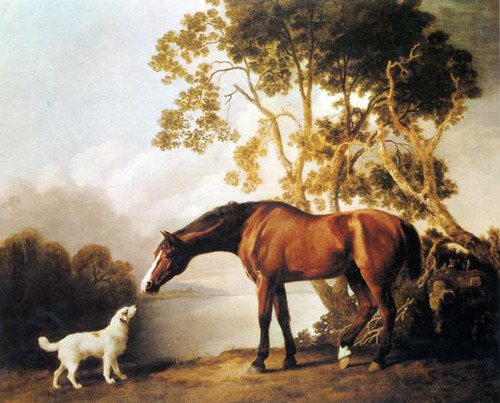
[Paintings by George Stubbs.]


Saturday, September 22, 2012

Homeless, Not Hopeless: Part Three


Well, I didn’t expect this news to be Part Three of the saga, but I should know by now that expectations often miss the mark.

I was just informed that the cat I introduced you to earlier this week—this Adopt-A-Less-Adoptable-Pet Week—has modified the spelling of his name to reflect the proper Spanish. Carbone is now Carbón.

As much as I’d like to honor this change, Google and I are currently battling for dominance over my blog and I am unable to alter the spelling. I’ll try again later, but at least I’ve managed to acknowledge the correction.

By the way, visit the Facebook page of Hope Springs Resort to see additional pictures of Carbón posted by hotel guests.

Tuesday, September 18, 2012

Homeless, Not Hopeless: Part Two

The Nomadic Feline
Back in 2003, a disheveled and wounded feline found his way to Hope Springs Resort, a boutique spa hotel in Desert Hot Springs, California. He’d been in a bloody battle, and by the looks of him, he wasn’t the victor.

He chose his sanctuary well, though. The owners of the aptly named hotel tended to his needs: cleaned up and nursed his injuries, fed him food and water, and bestowed him with a name. Thereafter Carbone, as he’d been christened, continued living on the streets and in the desert, but popped into Hope Springs from time to time for some TLC—especially after being terrorized by another cat or wild animal. “Live and let live” seemed to be the black cat’s motto.


The Defeated Warrior
Carbone was no kitten when he first appeared at Hope Springs, and nine years have since gone by. His ratio of outdoor time to indoor time—that is, solitary time to bonding-with-humans time—has flipped. He now sleeps in the bed of the resident hotel dog or with hotel guests in their rooms; he uses a litter box, and relies completely on hotel staff to provide his nourishment. He still roams outside periodically (the staff have no foolproof way of keeping him inside), but clearly Carbone’s need for outdoor freedom pales when compared to his need for consistent care and companionship.


Though he came from the streets, Carbone is neither aggressive nor assertive enough to defend himself. Hector, his canine pal at Hope Springs, defends him by chasing other cats off the property, but can’t protect him if Carbone wanders off by himself. The result? Carbone returns to Hope Springs, as he did again last week, with new wounds demanding veterinary attention (and the dreaded cone). This is the second time in the past 10 months that Carbone has met with disaster on the streets, and his ability to bounce back from these altercations has substantially diminished.


The Resort Pet
Carbone’s health and safety are at risk in the desert, especially as he ages. It’s time for him to transition to an indoor life.

Visitors and staff at Hope Springs continue to come and go, yet Carbone remains. The current hotel staff believe that the best gift they can offer him is a new home where he can rely on one set of people for affection, care, and comfort—a home where he can be an indoor-only, only cat so feline fighting becomes a distant memory for him; a home where consistency and permanence replace irregularity and transience. He has a lot of years left in him and deserves so much more than he can get from the hotel.


Spread the Word

Let’s get the message out that an American Shorthair is looking for someone to love. Here are his vitals: Carbone has a black coat complemented with some white, yellow eyes, and misshapen ears thanks to the bullies of the ’hood. He’s been neutered and is in overall good physical health. He’s a polite traveler and gets into his carrier without a fuss. Though he has his claws, he’s never used them on anything inside—only on the palm trees outside (the desert’s answer to a scratching post).

Yes, there will be a transition period for Carbone to acclimate to being an indoor-only cat in an entirely new environment. For instance, unless his new people have a palm tree in their living room, he’ll have to be introduced to scratching posts and learn how to use them. But he is not a feral cat and should be able to adjust without a lot of drama or mistakes.

Won’t you help Carbone find a safe haven—a place where he’s not challenged and beaten down by his own kind, where he can relax indoors and finally share his loving personality with people he can call his own?


Get Carbone a Home
As I wrote yesterday, this week is “Adopt-A-Less-Adoptable-Pet Week.” And Carbone certainly falls into that category: He’s black, he’s older, and his pacifist traits nearly qualify him as special-needs. Honor the week by helping this adoption-challenged feline get adopted.

For anyone who has questions about Carbone or interest in adopting him, call 760 329 4003, e-mail manager at hopespringsresort dot com, or go to the Hope Springs Resort Facebook page.


[Pics by N. J. Jackson.]

Monday, September 17, 2012

Homeless, Not Hopeless: Part One

September brims with crazy custom celebrations and observances. For instance, did you know it’s Be Kind To Editors & Writers Month and Update Your Résumé Month? There are whole weeks devoted to some topics (waffles, chimney safety) and 24 hours to others (pirate vernacular, building and code staff).

Today begins a weeklong observance called “Adopt-A-Less-Adoptable-Pet Week.” From September 17th through September 23th, the homeless-animal focus is on all the critters who have the hardest time getting adopted:
- the black ones
- the shy ones
- the old ones
- the differently abled ones
- the special-needs ones


These animals either spend an inordinate amount of time in shelters or they’re short-listed for death. Adopt-A-Less-Adoptable-Pet Week was started to build an awareness for these adoption-challenged and to inspire us to open our hearts to them. Case in point: Carbón. Stay tuned for his story.


[Photo by N. J. Jackson.]

Saturday, August 25, 2012

Groupon Wants My Feedback


Like thousands of other Americans, I have taken advantage of some of the discounts offered by Groupon. After my most recent deal, Groupon e-mailed me a “survey” about my experience—a private trail ride on horseback.

I wonder if the survey tactic is new for Groupon. They certainly didn’t ask me how I felt about the piece-of-crap keyboard I bought through them last spring. Anyway, I was happy to oblige.

The trouble was the structure of the survey. It allowed me to choose only one of two options, with no provision for comments or explanation: 1) I enjoyed ________ Stables and would recommend it to others, or 2) I did not enjoy ________ Stables and would not recommend it to others. Though this would seem to be the easiest kind of decision to make—as it would have been had I been asked about that useless keyboard—in this particular case, it was not.

The trail ride (actually, there was no trail; we just meandered through fields of wildflowers and butterflies) was fine. We were treated well and received what we were promised. For animal lovers, the place was a dream: 70 horses (including yearlings and seniors), a pony, a donkey, a variety of dogs from pug puppies to an ancient mastiff, cats, a rabbit, and a free-range pig.

However, for animal lovers, the place was also a nightmare: One dog was tethered to a tree, the cats were bony with opossum-like tails, tumors covered the large dogs, the pig’s stomach dragged the ground, and the rabbit—after surviving life at a research facility—seemed desperate to escape its small, filthy cage.

This father-daughter operation includes riding lessons, horse breeding, dog breeding, competitions—and no help. We learned that half of this business duo was out of commission, struck by cancer. The daughter, while performing caregiving duties for her father, managed the farm by herself. Times were tough and getting tougher.

So, did the daughter partner with Groupon in hopes of garnering repeat business? Or was she simply going for an influx of cash? Her farm sorely needs both scenarios, which is why I didn’t want to choose “No” on the Groupon survey.

On the other hand, how can I recommend a business where animals are not given proper vet care, many animals have to forage for their own food and water, and breeding principles are hardly recognized? Sadly, these issues probably aren’t the result of the father-daughter’s recent misfortunes. More likely they’re the result of a faulty philosophy about animal welfare. Worse, I suspect this farm isn’t an anomaly; there are hundreds, maybe thousands more like it across the country.

Had Groupon devised an e-mail survey with more options—for instance, a series of value statements that rated my experience—I might have been able to give the desired feedback. As it was, though, I chose the only other option left: I deleted it.

[Painting of horse by Gustave Caillebotte; painting of pig by Stephen Filarsky.]


Related Posts Plugin for WordPress, Blogger...