Showing posts with label rescue. Show all posts

Saturday, October 6, 2012

Trailer Tales: Balancing Evil with Big-Hearted Behavior

As you may imagine, my reading is frequently filled with the unconscionable things people do to animals. Here are a few I’ve come across since Wednesday:

1. To desensitize the horse who doesn’t like having his/her ears touched, some folks twist and pull the horse’s ears, sometimes to the point of breaking the cartilage. It’s an Old West version of “If you don’t stop crying, I’ll give you something to cry about.” A blogger believed this had been done to the horse she’d recently adopted and is now rehabilitating.

2. To counter the horse who fights having a bit in her/his mouth, some folks turn the horse’s head to the side and tie the tight rein to a stirrup (the one connected to the saddle on the horse’s back). They may leave the horse immobilized in that position for hours. One blogger suggests: “Before you think of doing this to your horse, tie the top of your head to your knee with a shortened length of rope and see what you learn!”

3. To retire a breeder dog who’s no longer a top producer, one option is to dump her along a road. One such dog was discovered near San Francisco this week—thrown from a car, bloody, emaciated, still swollen from her recent (and final) litter. Thankfully, a Good Samaritan found her and took her to BadRap Barn.

My ability to sift and steel through these stories fluctuates. I don’t share many of them on Lull because I want to spare you the disgust and hopelessness and rage and sick, sick feelings these atrocities bring out in me. And yet, I believe we have to be aware of some (though not all) of these situations if we want to change the world. We need to know the details in order to prevent them from happening in the future. We need to know our enemies and how they operate.

“People have forgotten this truth,” the fox said. “But you mustn’t forget it. You become responsible forever for what you’ve tamed.”
—from The Little Prince, by Antoine de Saint-Exupéry

Are you still reading? I hope so, because we’re finally getting to the good stuff—the other side of the balance sheet. The two positive stories I heard or read this week each involve a horse trailer…

Anna Blake, a horse trainer, wrote about a client of hers who was moving to a new state. The first piece of good news is that, unlike so many people who get rid of their animals before moving (or even before going on vacation), the client was taking her critters along. What’s more, the client insisted on riding in the trailer with them: three draft horses, two donkeys, and a parrot—each a rescue, each with some kind of challenge. The woman packed a cooler, a sleeping bag, and a chaise longue into the trailer and settled in for the 26-hour ride. She would spend that time calming her companions and watching for signs of discomfort or illness.

I love her deep concern and care for her charges. This warm-and-fuzzy story alone was enough to buoy my emotions over the evils roiling within my reading reach. But last night I heard about a more impressive animal advocate.

A woman (a friend of a friend) attended an auction in Pennsylvania (I don’t know which one; my friend was lean on details) with trailer in tow because she fully expected to purchase a horse. She stayed for the whole auction, but by its end, she didn’t hold the winning bid for anyone. She would be going home to her 700+-acre farm with an empty trailer.

She returned to her vehicle only to find FOUR creatures packed into her trailer! Someone apparently hadn’t sold them and, not wanting to keep the horses any longer, dumped them in the least guilt-inducing way that came to mind: Leave the animals in someone else’s trailer—make the animals someone else’s problem.

Fortunately for the ponies, the friend of my friend is not the abandoning kind. She shifted her mindset from going home empty-trailered to planning how to introduce her herd at home to these four new horses—horses who might otherwise have ended up taking that long, painful journey to the abattoirs South of the Border.

Some folks simply don’t know how to be good; they need role models to emulate. Other folks? Well, they bewilder me. But I’ll keep searching for a way in to their deeply hidden reserve of emotional intelligence.

Meanwhile, let’s circulate these trailer tales. They’re spirit-lifting, plus they might prompt others to tap into their own goodness the next time an opportunity arises.

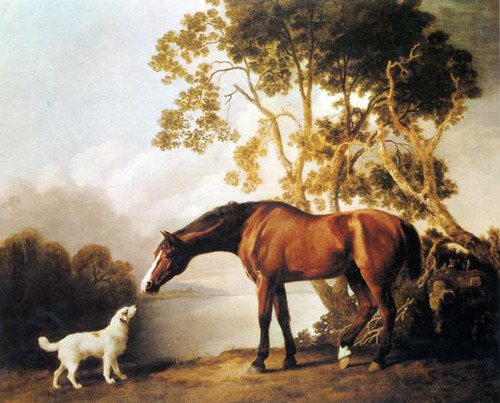
[Paintings by George Stubbs.]


Sunday, September 11, 2011

9.11: Ten Years On, An Eternity Ahead

It’s here again. Yet another year has rolled by since September 11, 2001.

In observance of the first-year anniversary, my husband and I chose to thumb our noses at terrorism by taking a transatlantic flight on September 11, 2002. It felt great to be among the “courageous” few in the air that day. From London to Chicago, we felt invincible.

In observance of this anniversary, as everyone remembers the heroes and victims of the day, I have one message: Don’t forget about the dogs.

More than 300 pooches (no one knows the exact number because some came as part of an organized effort, others showed up with handlers out of the blue) searched the 9.11 sites for people, living or dead. You can see them in action in the video Hero Dogs of 9/11 at Dog Files.

As you watch, you’ll get a sense of the scale of the disaster and wonder how those dogs fared afterward. Did they, like the human workers, suffer from cancers, respiratory diseases, and various other ailments? Surprisingly No, according to a study conducted by the very vet, Cynthia Otto, who was at Ground Zero administering care to the canines.

As dogs’ lives are distressingly short, the 9.11 rescue dogs are now either old or have moved on to another world. The New York Times has a slide show of the oldsters, who will soon be published in the new book Retrieved by Charlotte Dumas. There’s a 10th anniversary edition out of Dog Heroes of September 11th and a Web site of related pics. For the dogs who participated in the health study, Otto created a memorial to the ones who’ve passed on.

So long as we live, they too shall live, for they are now a part of us,
as we remember them.

—From a Jewish prayer

[Photo from Dog Files.]

Thursday, June 16, 2011

Help Hank Get A Home

Hey, Lull readers! If you’re on Facebook, maybe you can help this furry fellow.

Hank (a temporary name) was found by a woman in Palm Springs, California, who took him to her vet, where the following was revealed:

Hank had traveled a significant distance to get to Palm Springs—100 miles. He was chipped, but his guardian recently died. He loves people and gets along great with dogs. One of his legs was once broken and has now healed, so he wouldn’t make a sound running partner. But he walks fine and isn’t bothered by it.

What’s more, he’s got a winning smile—even after all he’s been through.

I know a million pooches are looking for homes as I write, but this is the one that’s front and center right now. Please help spread the word about him.

For more information, e-mail lilloflull at gmail dot com.

Saturday, April 2, 2011

Bow-WOW! Castaway Pooch Rescued in Japan

Did you see the news yesterday? The Coast Guard spotted life atop a roof floating off the coast of Japan. Against all odds, a dog was afloat wreckage from Japan’s earthquake-tsunami disaster of three weeks ago.

Can you imagine the rush those rescuers got from 1) Just finding anything alive, and 2) Successfully liberating the creature from certain death?

It took several hours—the initial helicopter attempt to reach the dog frightened it—but the boat operation finally triumphed.

Get that dog an agent! His/her Life of Pi–sized story is certainly bookworthy—maybe even destined for the Silver Screen. Think about it: Where was the pooch when the earthquake hit? Was anyone with him/her? How did s/he get to the roof? What did s/he experience once adrift? How did s/he stay alive? What made him/her press on?

[Idea for publishing community: Why not create something gratis and send ALL the revenues to Japan to fund animal shelters and caregivers?]

Kudos to the team of rescuers for deeming a canine’s life worth saving and for risking their lives to do it.

La chaim!

[AP photo.]

Saturday, February 12, 2011

Coming to Grips with the Age of Snark

Generally, I’m not fond of snarky writing. I know I’m in the minority when I admit this; I realize snark is popular today—defines our culture. And I don’t dismiss it out of hand: I’ve been known to laugh at well-written snarkiness. But when such writing is used for good, then I’m a fan.

Case in point: the Fugly Horse of the Day! blog.

As you might have imagined, my move to the Horse Capital of the World has influenced my Web reading and expanded my awareness of equine racing and rescue. I happened upon Fugly one day and have continued to follow it.

The Californian behind Fugly gets the word out about abuse (in training, in breeding, in care) and horses in need while giving the abusers a well-deserved slap of snarkiness. But more than that, she rallies horsepeople across the country to DO something on behalf of the creatures she profiles. Readers share information with one another, research lineage, call someone who knows someone else who can get the media involved in a situation or who can get the facts about an alleged crisis, help find new homes for ponies destined to become some
one’s dinner. She presses readers to press their local politicians to add teeth to animal welfare laws and enforce those laws—not just sometimes but all the time. (All too often, authorities give abusers a pass in order to remove the animals without a fight. This does not prevent the abusers from acquiring more animals, nor does it change the abusers’ behavior.)

Yeah, I know. It’s not like this blogger is mobilizing an entire nation to fight for justice as we recently witnessed in Egypt. But she’s shouting out for one creature on our planet who has no voice (or isn’t listened to). She’s doing what she can where she is. And that MATTERS.

[Pics from Save A Forgotten Equine are Dexter upon rescue (top) and a year later after receiving appropriate care.]

Tuesday, November 16, 2010

Cupcakes to the Rescue!

This is Evil Knievel, hoping you Los Angeles-area Lull readers will head over to the Music Box Theater this Saturday and eat a cupcake.

Cupcake Camp L.A. will be there raising money for several charities, including American Tortoise Rescue and Angel Acres Horse Haven Rescue.

Prepare your sweet tooth for a good cause.

Saturday, November 13, 2010

Thinking About Not Thinking

I’ve just turned the last page of Dark Horses and Black Beauties. I’m glad I read it, but it was a workout in facing the facts about human nature and our dearth of kindness. I shudder to imagine the overwhelming amount of depressing and shocking minutiae author Melissa Holbrook Pierson had to sift through for the book. Here’s a single paragraph—sans stomach-turning descriptive details—to consider:

The toll of horse life on the battlefields of human wars can hardly be conceived. With Napoleon in Russia, one division lost 18,000 of 43,000 mounts in the space of two months; in the 1812 retreat from Moscow, 30,000 horses died, mainly from cold and privation. The Peninsular War caused Wellington to call the Peninsula “the grave of horses”: the 14th Light Dragoons alone lost 1,564 horses (of 1,840 total), while their loss of men was 654. The Boer War cost the lives of some 500,000 horses, mules, and donkeys (the Australians shot all their surviving Walers over the age of twelve when the war ended, since they couldn’t be returned home due to quarantine restrictions). In World War II, Germany lost an average of 865 horses per day over the war’s two thousand days—52,000 in the Battle of Stalingrad alone. (Entire libraries of books are written about this war without any mention of the millions of animals who perished.) One day in 1939 the Pomeranian Cavalry Brigade lost 2,000 horses in thirty minutes; a witness described the road to Warsaw as lined with thousands of dead and dying horses. The annihilating charge of the Polish cavalry against German Panzer tank divisions stands today as the very emblem of grotesque futility. You will note that this very partial accounting begins only with the nineteenth century.

My reading since September has centered on animals, yet revealed some of the darker choices of humankind. My first impulse was to skip the awful passages of the books, but then I would have remained uninformed. My second urge was to share what I’d learned on Lull: explain my sorrow, which would partially explain my infrequent posts. But that would have required further examination of the material. So instead, I just continued reading and feeling trapped inside a vortex of suffering—easily imagining the fear and pain inflicted upon the creatures and characters of both the nonfiction and fiction of my reading lineup. (See books listed at right in “Current Reading Lineup” and “Books Read in 2010.”)

The price of a rescue story is being made aware of the cruelty or neglect that necessitated the intervention. But some of us pay again in the form of guilt and shame for either not knowing what to do or not doing enough in such situations.

I’ve decided to take a break from the bleak and turn to short fiction from a few favorite novelists. Otherwise, my ability to recognize and savor beauty in the everyday may fade. And then, what’s the point?

[See the story behind “Hitler’s Horse.”]
Related Posts Plugin for WordPress, Blogger...