[Art by Erin Smith.]
Showing posts with label animal rescue. Show all posts
Friday, March 15, 2013
Tuesday, January 8, 2013
Extremely Large and Incredibly Close
As a child I enjoyed reading The Happy Little Whale, a Golden Book starring a sperm whale, and I’ve harbored a soft spot for the ocean giants ever since.
Not surprisingly, when news hit the mainstream press last year of an underwater whale rescue, I paid close attention. Turns out it wasn’t a whale, but a whale shark. No matter, the creature was in trouble.
Off the coast of Mexico, a group of vacationers were diving and enjoying the playful antics of the indigenous sea life. However, getting up close and personal with ocean residents means seeing a dark side as well (the dark side of humans, that is). One whale shark showed scarred and grooved skin from a boat propeller; another was hampered by a tuna net that had wrapped like a rope around the shark and lodged into his/her skin and cut deeply into a fin. When professional divemaster Daniel Zapata noticed it, he knew he had to help.
With a knife, a little courage, and a lot of compassion, Zapata went to work on the net—swimming above the polka-dotted leviathan and cutting him/her free at the same time. Here’s a short version of the scene (Zapata’s company, Solmar V, offers a longer version of the dive; the whale shark appears around 4:24):
When searching for links to this rescue, I found another one—this time with a humpback whale. Michael Fishbach, cofounder of the Great Whale Conservancy, was monitoring whales in the Sea of Cortez on Valentine’s Day of 2011, accompanied by family and friends. Near their boat was a young, presumably dead humpback whale. Dead, that is, until she let go a distressed exhale.
Fishbach dove into the water for a closer look and found the whale entangled in nylon fishnets, like those used by the local fishers (doesn’t this make you think of all the plastic debris in our waters and how it affects wildlife, large or small?). Her fins were pinned to the sides of her body and her tail was weighted down about 15 feet. She was immobilized, frightened, and dying.
Fishbach radioed for help, but was told IF anyone could get there, it would be at least an hour before they arrived. Fishbach and his mates knew that would be too late, so they threw themselves into action—some worked in the water, others worked from the boat, all cut and pulled and disentangled. This rescue took a LOT of courage and the compassion of MANY people (watch to the end of the video and you’ll see the rescuers’ reward for their care), for one unexpected move from this huge patient could spell disaster for the humans:
I don’t know about you, but I am so-ooo-oo grateful there are folks like Fishbach and Zapata in the world—folks who have big hearts and the chutzpah to take action. I’m guessing that, on some level, those two ocean giants feel the same.
Not surprisingly, when news hit the mainstream press last year of an underwater whale rescue, I paid close attention. Turns out it wasn’t a whale, but a whale shark. No matter, the creature was in trouble.
Off the coast of Mexico, a group of vacationers were diving and enjoying the playful antics of the indigenous sea life. However, getting up close and personal with ocean residents means seeing a dark side as well (the dark side of humans, that is). One whale shark showed scarred and grooved skin from a boat propeller; another was hampered by a tuna net that had wrapped like a rope around the shark and lodged into his/her skin and cut deeply into a fin. When professional divemaster Daniel Zapata noticed it, he knew he had to help.
With a knife, a little courage, and a lot of compassion, Zapata went to work on the net—swimming above the polka-dotted leviathan and cutting him/her free at the same time. Here’s a short version of the scene (Zapata’s company, Solmar V, offers a longer version of the dive; the whale shark appears around 4:24):
When searching for links to this rescue, I found another one—this time with a humpback whale. Michael Fishbach, cofounder of the Great Whale Conservancy, was monitoring whales in the Sea of Cortez on Valentine’s Day of 2011, accompanied by family and friends. Near their boat was a young, presumably dead humpback whale. Dead, that is, until she let go a distressed exhale.
Fishbach dove into the water for a closer look and found the whale entangled in nylon fishnets, like those used by the local fishers (doesn’t this make you think of all the plastic debris in our waters and how it affects wildlife, large or small?). Her fins were pinned to the sides of her body and her tail was weighted down about 15 feet. She was immobilized, frightened, and dying.
Fishbach radioed for help, but was told IF anyone could get there, it would be at least an hour before they arrived. Fishbach and his mates knew that would be too late, so they threw themselves into action—some worked in the water, others worked from the boat, all cut and pulled and disentangled. This rescue took a LOT of courage and the compassion of MANY people (watch to the end of the video and you’ll see the rescuers’ reward for their care), for one unexpected move from this huge patient could spell disaster for the humans:
I don’t know about you, but I am so-ooo-oo grateful there are folks like Fishbach and Zapata in the world—folks who have big hearts and the chutzpah to take action. I’m guessing that, on some level, those two ocean giants feel the same.
Sunday, September 9, 2012
I Started A Joke, Which Started …
Yeah, it started in a New York City bar with a prank that involved a live chicken. The prank was thoughtfully strategized, a chicken was procured, and all went well—for both the prankster and the victims. But then came the part of the plan for which no one had a plan: What should be done with the chicken?
I don’t know how many subhumans knocked their skulls together to come up with the idea, but somehow they decided to place the chicken in a garbage bag and put it into the trash bin behind the bar.
That’s the point when our hero, Sean, entered the frame. What would you do if you noticed that a bag being added to some trash was MOVING?
Sean took action immediately—and by himself. No calls to Animal Control, no waiting until the prankster ducked inside. Nosirree. Sean asked what was moving inside the bag and the man told him the story above. The man said he didn’t know what else to do. [When did thinking become so monumentally difficult for our species?]
Sean wasn’t sure what to do, either, but he knew leaving a live chicken in a trash bag was NOT an option. He also knew the two cats back home in his apartment—not to mention his landlord—probably wouldn’t appreciate a new feathered companion.
So Sean called Catskill Animal Sanctuary (CAS), and they agreed to provide a new home for Roxbury the chicken.
But wait! The story gets better: Sean took his rescue one step further by signing on as Roxbury’s sponsor at CAS, and Sean’s girlfriend, Marlene—after holding Roxbury and seeing her as something more than dinner—vowed to never eat chicken again. Two people who weren’t actively engaged in animal welfare suddenly changed their lives and their perspectives because of an ill-conceived joke.
It’s National Chicken Month again, dear readers. This year, let’s celebrate by giving a hand to Sean—a fellow who, through happenstance and compassion, made a big difference in one little chicken’s world.
[Pic of Roxbury from Catskill Animal Sanctuary.]
I don’t know how many subhumans knocked their skulls together to come up with the idea, but somehow they decided to place the chicken in a garbage bag and put it into the trash bin behind the bar.
That’s the point when our hero, Sean, entered the frame. What would you do if you noticed that a bag being added to some trash was MOVING?
Sean took action immediately—and by himself. No calls to Animal Control, no waiting until the prankster ducked inside. Nosirree. Sean asked what was moving inside the bag and the man told him the story above. The man said he didn’t know what else to do. [When did thinking become so monumentally difficult for our species?]
Sean wasn’t sure what to do, either, but he knew leaving a live chicken in a trash bag was NOT an option. He also knew the two cats back home in his apartment—not to mention his landlord—probably wouldn’t appreciate a new feathered companion.
So Sean called Catskill Animal Sanctuary (CAS), and they agreed to provide a new home for Roxbury the chicken.
“The
fate of animals is of greater importance to me than the fear of
appearing ridiculous; it is indissolubly connected with the fate of
men.”
—Émile Zola
—Émile Zola
But wait! The story gets better: Sean took his rescue one step further by signing on as Roxbury’s sponsor at CAS, and Sean’s girlfriend, Marlene—after holding Roxbury and seeing her as something more than dinner—vowed to never eat chicken again. Two people who weren’t actively engaged in animal welfare suddenly changed their lives and their perspectives because of an ill-conceived joke.
It’s National Chicken Month again, dear readers. This year, let’s celebrate by giving a hand to Sean—a fellow who, through happenstance and compassion, made a big difference in one little chicken’s world.
[Pic of Roxbury from Catskill Animal Sanctuary.]
Monday, September 3, 2012
Calling Out Animal Cruelty: Is It Interference or Intervention?
Over coffee this summer, a friend expressed her anger at some nameless person who accused her neighbor of animal cruelty. Animal-control officials visited this neighbor and told her the anonymous caller had reported seeing her dog limping slowly and with great difficulty on a walk. The officials needed to determine why and to what extent the dog’s mobility was impaired.
I understood my friend’s ire on behalf of her neighbor. The truth was that the dog was ancient and suffering from arthritis. The dog’s guardian had not been able to make the necessary end-of-life decision she knew it was time for. Yes, the dog was in pain—which the woman and her vet were trying to manage—but the cause was not what the anonymous caller had imagined.
I told my friend what I’d heard the previous month at a public forum regarding the Kentucky Livestock Care Standards Commission. A spokesperson for the Kentucky Horse Council derided every concerned citizen who had ever lodged complaints against horse businesses. She said outsiders were uninformed about equine care and they reported things like deep spring mud and summer fly masks as neglect and cruelty, respectively. In the context of the forum, she was drawing a line between farms/the equine industry and animal welfare advocates. Like my friend’s neighbor, this representative for horses (well, really for the horse industry) viewed outsiders as annoyances—meddlers who stirred up trouble where there wasn’t any.
I can sympathize with both women. It’s frustrating and hurtful to be accused of something you didn’t do. It’s time-consuming to deal with such issues and to set the record straight.
But I think about a comment I read last year on the Web. The commenter described a dog tied up in an Alabama backyard—a dog who had no shelter, no exercise, no freedom of movement, no food, and no water. The writer meant to vilify the dog’s “guardian” for neglect, but in the end, readers learned that the writer witnessed this scene for an entire YEAR on his/her way to work and not once reported it to authorities. The dog starved to death, its body left in the backyard to decompose.
Now I’d like to ask Ms. Kentucky Horse Council Spokesperson: Is it better that citizens say nothing about what they see?
Sometimes … no, actually too frequently citizens report neglect or cruelty only to find that authorities do nothing. Cricket (who is pictured on the right of the photo with her new friends, one of whom is wearing a fly mask, at Catskill Animal Sanctuary; her rescue last year was reported on Lull) was once chained to a tree—with no accessible food or water in sight—on the farm she shared with other ill-cared-for animals. Passersby noticed first, then animal-rescue folks got involved, and though all these caring people jumped through every legal hoop required, the authorities took ONE YEAR before acting on the complaints. Turns out Cricket’s “guardian” was the very same hoarder who had surrendered animals to Catskill Animal Sanctuary 10 years earlier! New farm, new critters, same psycho. (My apologies to hoarders for my harsh language. I realize hoarding is an illness. But I also know that without medical attention, you will not change.)
Again, Ms. Kentucky Horse Council Spokesperson: When a horse is tethered to a tree by a short chain that not only prohibits her movements but bores into her flesh, should nonhorsepeople keep their mouths shut because they know so little about horses? Should concerned citizens refrain from getting involved in case they’ve misinterpreted the situation?
I think not. Clearly, we need authorities (legislators, animal-control agencies, police, judges, lawyers) who are better informed about animal welfare, who take it seriously, and who take action when it’s required. But we also need more “meddlers” who have the courage to speak out for those who cannot. Some of their reports may be off-base (as was the case with the geriatric pooch described above, though the woman said the event nudged her into making the right decision for her dog); but others will be valid cases demanding immediate involvement. It’s possible that behind the neglected animal is also a neglected senior or child. It’s also possible that behind a neglected animal are people in dire circumstances who could use assistance themselves. Or maybe, as in the case of the Pit Bull guardian I yelled at last year, the person is simply uninformed/misinformed about the care of the animal.
Sometimes intervention IS interference. But in the long run, we can tolerate it, can’t we? Let’s let the meddlers speak* and let’s hear what they have to say. Let’s SEE what’s happening around us—notice the vulnerable amongst us and have the backbone to speak out on their behalf.
* Please, oh puhleeze check out the story of Mr. Chips at The Literary Horse, in which Mr. Chips discovers bliss and attracts the Long Arm of the Law. But choose carefully where you read this tale: Laughter is guaranteed. (In fact, I encourage you to read every Mr. Chips tale in the series.)
[Photo of 17-year-old pooch taken in Montana by Nancy LeVine and included in her book, Senior Dogs Across America.]
I understood my friend’s ire on behalf of her neighbor. The truth was that the dog was ancient and suffering from arthritis. The dog’s guardian had not been able to make the necessary end-of-life decision she knew it was time for. Yes, the dog was in pain—which the woman and her vet were trying to manage—but the cause was not what the anonymous caller had imagined.
I told my friend what I’d heard the previous month at a public forum regarding the Kentucky Livestock Care Standards Commission. A spokesperson for the Kentucky Horse Council derided every concerned citizen who had ever lodged complaints against horse businesses. She said outsiders were uninformed about equine care and they reported things like deep spring mud and summer fly masks as neglect and cruelty, respectively. In the context of the forum, she was drawing a line between farms/the equine industry and animal welfare advocates. Like my friend’s neighbor, this representative for horses (well, really for the horse industry) viewed outsiders as annoyances—meddlers who stirred up trouble where there wasn’t any.
I can sympathize with both women. It’s frustrating and hurtful to be accused of something you didn’t do. It’s time-consuming to deal with such issues and to set the record straight.
But I think about a comment I read last year on the Web. The commenter described a dog tied up in an Alabama backyard—a dog who had no shelter, no exercise, no freedom of movement, no food, and no water. The writer meant to vilify the dog’s “guardian” for neglect, but in the end, readers learned that the writer witnessed this scene for an entire YEAR on his/her way to work and not once reported it to authorities. The dog starved to death, its body left in the backyard to decompose.
Now I’d like to ask Ms. Kentucky Horse Council Spokesperson: Is it better that citizens say nothing about what they see?
Sometimes … no, actually too frequently citizens report neglect or cruelty only to find that authorities do nothing. Cricket (who is pictured on the right of the photo with her new friends, one of whom is wearing a fly mask, at Catskill Animal Sanctuary; her rescue last year was reported on Lull) was once chained to a tree—with no accessible food or water in sight—on the farm she shared with other ill-cared-for animals. Passersby noticed first, then animal-rescue folks got involved, and though all these caring people jumped through every legal hoop required, the authorities took ONE YEAR before acting on the complaints. Turns out Cricket’s “guardian” was the very same hoarder who had surrendered animals to Catskill Animal Sanctuary 10 years earlier! New farm, new critters, same psycho. (My apologies to hoarders for my harsh language. I realize hoarding is an illness. But I also know that without medical attention, you will not change.)Again, Ms. Kentucky Horse Council Spokesperson: When a horse is tethered to a tree by a short chain that not only prohibits her movements but bores into her flesh, should nonhorsepeople keep their mouths shut because they know so little about horses? Should concerned citizens refrain from getting involved in case they’ve misinterpreted the situation?
I think not. Clearly, we need authorities (legislators, animal-control agencies, police, judges, lawyers) who are better informed about animal welfare, who take it seriously, and who take action when it’s required. But we also need more “meddlers” who have the courage to speak out for those who cannot. Some of their reports may be off-base (as was the case with the geriatric pooch described above, though the woman said the event nudged her into making the right decision for her dog); but others will be valid cases demanding immediate involvement. It’s possible that behind the neglected animal is also a neglected senior or child. It’s also possible that behind a neglected animal are people in dire circumstances who could use assistance themselves. Or maybe, as in the case of the Pit Bull guardian I yelled at last year, the person is simply uninformed/misinformed about the care of the animal.
Sometimes intervention IS interference. But in the long run, we can tolerate it, can’t we? Let’s let the meddlers speak* and let’s hear what they have to say. Let’s SEE what’s happening around us—notice the vulnerable amongst us and have the backbone to speak out on their behalf.
* Please, oh puhleeze check out the story of Mr. Chips at The Literary Horse, in which Mr. Chips discovers bliss and attracts the Long Arm of the Law. But choose carefully where you read this tale: Laughter is guaranteed. (In fact, I encourage you to read every Mr. Chips tale in the series.)
[Photo of 17-year-old pooch taken in Montana by Nancy LeVine and included in her book, Senior Dogs Across America.]
Wednesday, March 7, 2012
Doling Out Dolphin Love
This rescue story is all over the Internet, but I’m posting it here anyway. It’s a feel-good random act of interspecies kindness that’s a model for us all. Note how two men immediately rush to the aid of the dolphins, then others follow suit. I want to hug those two guys for their leadership and for acting so quickly.
You can get more details at Treehugger.com. (If you go there, stay to watch the video of the whale and dolphins playing “Slide.”)
Wednesday, June 29, 2011
Feeling Good By Doing Good
Earlier this month I asked Lull readers to help send food to animal shelters in tornado-struck Joplin, Missouri. The amount of kibble raised—661,300 pieces, equivalent to 66,130 clicks—wasn’t enough to get the match from Halo, the supplier of the food, but it was probably enough for several days of meals. (I’ve asked FreeKibble for meaningful numbers, i.e., bowls rather than tons or pounds or millions of pieces, but I haven’t heard back yet.)Since then, you probably heard about the blowout adoptathon for the animals that drew people from across the nation to Joplin. It was a huge success, yet hundreds of pets remain there without a home.
Like the animal shelters in Joplin, every rescue operation in America could use some help in keeping critters fed. So I’ve added the FreeKibble buttons to Lull—beneath the purple paw. Click on each of them daily to donate food (or more frequently if you’re so inclined).
Each site gives something in return: Through the purple paw you can pause to read a short, uplifting rescue tale; through the FreeKibble quiz you might learn some trivia ab
out canines and felines. And, of course, there’s that unquantifiable sensation of having made a difference in the world, which is a great way to either start your day or end it. As Lull reader M. K. wrote to me recently:“I start my day every morning going to both of the food for animal shelter sites, so even if the rest of the day sucks I know I’ve done something good.”
So go ahead and Make My Day … by feeding the homeless. It’ll make your day, too.
[Pics from Petfinder.com.]
Saturday, June 25, 2011
A Match Made In Heaven
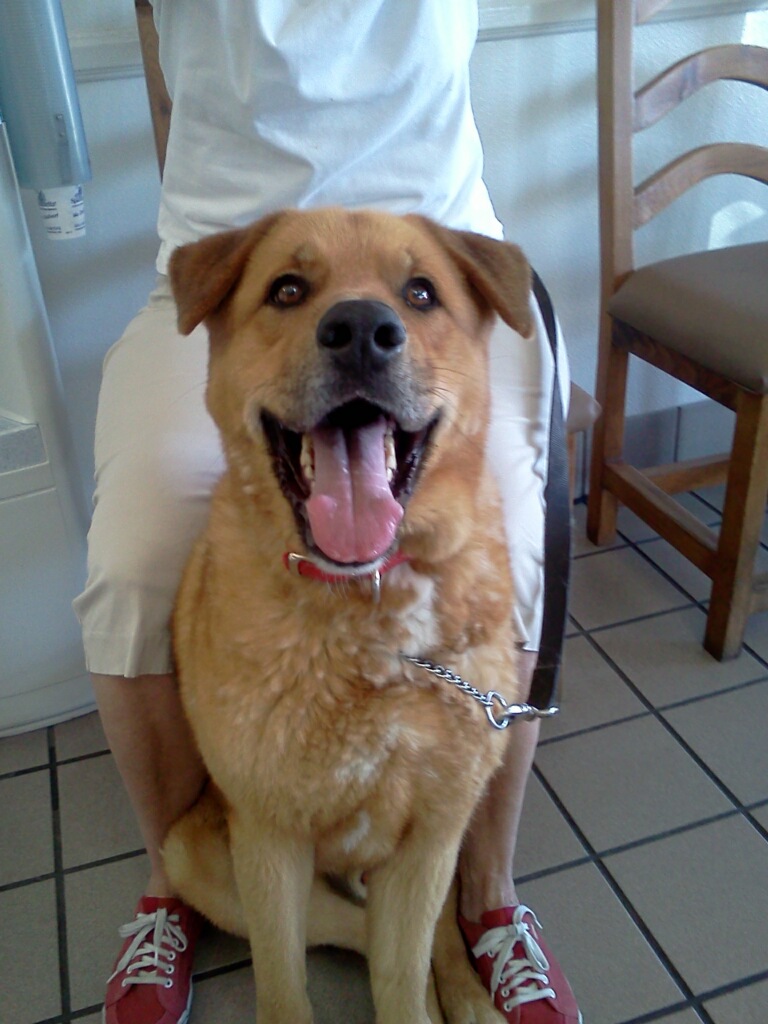
Remember Hank?He was rescued in the California desert, 100 miles from his home. His human companion had died, but these were the only details his microchip revealed.
Don’t you wonder what happened to Hank after he lost his person? Did anyone take him in? Did someone dump him? Where was he headed when he set off on his trek? Had he visited the desert before? Or was he roaming with no particular destination in mind? How many people saw him? How many tried to help him?
He’s a friendly bloke, as you can see in these photos with a friend—eager to please, a glutton for affection.

Hank’s big personality won someone’s heart this week, someone whose heart had been wounded by the recent loss of his one-and-only canine companion.
It’s coincidence, of course. Any one of us could have fallen for the golden boy of Chow Chow heritage. But we like a good story, don’t we, sprinkled with a dash of mystery?
What better story could there be than two creatures, each recovering from a significant loss, who are celestially guided (by the ones they lost?) to each other? One hundred miles toward love. One hundred miles toward home.
Hank really has something to smile about now.
Thursday, June 2, 2011
Today Only: Play A Game, Feed Joplin’s Homeless
This kind of breaking news often comes to me too late. However, if you’re reading this on Thursday, 2 June 2011, then you still have time to make a difference for the animals of Joplin, Missouri, who lost their homes to a tornado.The FreeKibble “game” is one multiple-choice question, but you can choose to play more questions if you wish. And you can revisit the site throughout the day. Just choose Bow Wow Trivia or Meow Trivia or both.
This site donates food every day to shelters, but today the goods are dedicated to Joplin alone. Plus, if 1 million pieces are reached, the Halo pet food company will match it. (Halo is wholesome food for any pet and not typically the brand served in shelters.)
So let’s help the homeless four-leggeds get some highly nutritional food while th
ey’re waiting for their old families or their adopters. Every click is worth 10 pieces of kibble.[You can see some of the unclaimed pets (including birds, turtles, ferrets, and rabbits) on the home page of the Joplin Humane Society.]
A BIG THANK-YOU to the Lull reader who passed along this information!
Tuesday, May 31, 2011
Sophie’s Choice: The Decisions That Transform Our Lives
I’ve been thinking even more lately about our departed one-in-a-million pooch—partly because I’ve started volunteering at a shelter, but mostly because we used to celebrate her birthday in May. May was the month 13 years ago that she pawed her way into our hearts.
Before yet another May goes by—this month that would have been her 15th birthday—I’d like to recount her adoption tale.

Envisioning A No-Kill Nation
It started with one woman’s notion that she could make a difference. Her aim was to turn a city with one of the country’s highest kill rates (the number of adoptable pets “euthanized” before finding a new home) into a no-kill city. She created an organization she named PAWS (Pets Are Worth Saving) and held her first adoption event in 1998.
It wasn’t the little booth setup near a store or festival we’re accustomed to today. The PAWS event covered the north end of the Magnificent Mile of the Windy City and turned into the block of posh boutiques that ended with Barneys New York. Every window of participating retailers in this shoppers’ mecca held puppies, kittens, cats, and dogs chosen from shelters across the city. (PAWS didn’t yet have a brick-and-mortar presence. Just a woman with a mission.)
Diamonds and Dalmatians? Luxury linens and Leonbergers? Purses and Pixie Bobs? Contrast captivates me and the PAWS event promised to deliver on this count alone. It was a must-see occasion for me.
For my husband, not so much. He acquiesced when we turned the outing into a bike ride and I assured him I had no intention of adding any animals to our recently reduced menagerie. (We were down from three felines to one. Plus our dancing-but-mute bird crossed into the other-world. New shades of quiet had enveloped our home.)
Biking Toward Our Future
When the big weekend came, so did a burst of hot weather. We took our time peddling along the lakefront bicycle path, dodging unaware walkers and parents with strollers. Seven miles later, we locked up our bikes near the Drake Hotel and commenced the tour.

Ralph Lauren sported Golden Retriever pups, natch! Escada boasted a Bluetick Coonhound. In the space Chanel had just abandoned for larger digs were rows of cats and puppies. On the floor next to the doorway was a lone adult dog in a too-small cage. You’d miss seeing her if it wasn’t for the ruckus she made every time a puppy was shepherded past her. She raised and extended a paw to us every time we looked at her.
She caught the eye of many, but inquirers were told she didn’t get along with other dogs. This was a deal-breaker, especially for folks who already had a dog in their households.
When the dog extended her paw, she also tilted her triangular-shaped head at a just-right angle and held our gaze with her liquid-brown doe eyes. She was deep-chested; her coat was white with brindle patches, but her head and floppy ears were pure chocolate.
We hung around long enough to hear her story: Her distrust of other canines likely stemmed from fear. It was believed she’d once been attacked by her own kind—a theory arrived at from both her behavior and the scores of scars on her back legs. Her presence at the PAWS event was a last-ditch effort to get her a home. She hadn’t been borrowed from the luxury accommodations of a shelter; she came from the Animal Care & Control Pound and her death had been scheduled for the next day. (At that time, the Pound hitched a bunch of dogs to a cart and wheeled them into a room to be gassed.)
We left. We had the boutiques yet to see and the event was drawing to a close. Already there were fewer animals to ooh and ahh over—they’d been adopted. Of course, my mind kept returning to that ultra-thin, Greyhoundish creature who was facing a very short future.
My husband and I had dreamed for years about getting a dog. It was part of the fantasy of owning our own home with the fenced-in yard…near the beach and miles away from neighbors. We’d even talked breeds (large) and names (Lola). We’d read about rescuing Greyhounds from the track. We’d also agreed that we couldn’t have a dog until our work schedules were sane and we lived at ground level.
Making Informed Decisions
At last we reached Barneys. We stepped inside to get a closer view of the furballs on display. Only one stood out. When my husband picked her up, the mutual affection was obvious. The woman overseeing the Barneys adoptions was also the foster mom to this particular kitten.
“I can’t believe it!” she said. “Everybody loves that kitten, but you’re the only one she’s shown any interest in.” She went on to say that the kitten was on hold for adoption. “But I’d prefer to see her go to you. She’s already bonded with you two. Will you take her?”
What was happening? We weren’t going to adopt anything one minute, and the next
we were going to let a dog die while we took home a kitten instead. I told the woman my husband and I needed to discuss the situation.
We left. What happened next is a matter of interpretation.
We proceeded to the nearest restaurant for a break and a bite to eat. To hear my husband’s version, I intentionally stuffed him with fried foods and a milkshake and sat him in the sun, whose heat cast a druglike spell over him and rendered him incapable of making any decisions or thwarting my evil plans.
I have to confess I felt just as overcome by the fried foods and sun, but I clearly remember the rationale I tried to present: The kitten was going to be adopted. She might not receive the same care and love we would have provided; she might not like her new family as much as she already liked us, but she’d have a home. The dog, on the other hand, was going to die. Tomorrow.
What failed to flicker in my brain? Here’s a short list:
1. Dogs were prohibited in our apartment building.
2. We knew nothing about dog behavior.
3. We didn’t know whether our remaining cat would accept a dog.
4. We were clueless about how dogs affect their guardians’ lifestyle.
5. We had no plan for bringing a canine into our household and no accommodations—bowls, bed, leash.
All I obsessed about was the imminent and gruesome passing of that doe-eyed pooch.
We returned to the former Chanel space. Maybe someone had adopted the dog and our decision would be made for us, I thought.
No such luck. The dog extended her paw to us as soon as we walked into the room.
Testing Our Hearts
We’d read enough about Greyhound rescues to know some of them can’t navigate stairs. If this dog was stair-challenged, how was she going to live in our third-floor apartment? We asked what was known about the dog; we were fed the same information we’d heard earlier.
“Would you like us to take her out of the cage for you?”
“Um, yeah, that would be good.”
Out she came and a leash was snapped onto her. “Walk around the atrium with her, if you’d like.”
The dog dutifully stayed close to us as we walked through the bevy of news correspondents and camera people who were about to interview PAWS’ founder. We headed for an out-of-the-way corner of the atrium and tested the pooch on some stairs. She was fine.
PAWS’ founder walked to our corner after her interview. It had been a long, successful weekend for her and she apologetically collapsed to the floor before talking to us.
An older, affluent woman approached us, remarking on how beautiful “our” dog was. “How long have you had her?” she asked.
“Our” dog was leaning into my husband at that point, placing her claim on him. We explained we were merely considering adopting her. “Well, she acts like she belongs to you. She’s made her decision.” As the woman left, we noticed her tiny canine peering out from her purse, which told us “our” dog didn’t have a problem with all dogs.
The PAWS founder began speaking. “Our” dog had been a special case for her—a real Sophie’s Choice (the rescue community’s phrase for the animals at Death’s door, i.e., the gas chamber). The woman kept talking but I’d stopped listening because just as she mentioned Sophie’s Choice, the background music swelled with the score from Schindler’s List.
Purely coincidental, right? Yet at that moment, the connection felt full of meaning. Made me dizzy (or was it that bloody lunch kicking in?). What forces were shifting in our lives? How many disparate elements had just converged to bring us to this moment?
I had no answer. I just wanted to get away from the crowd and go home with my husband and “our” dog.
Committing to Lifelong Guardianship
So we began the adoption process. Unfortunately, unlike the shelter adoptions being transacted that day, ours was a POUND transaction. If “our” dog had been at a shelter, we could have adopted her on the spot. However, the POUND required us to transport the animal all the way back to POUND HQ—along pothole-filled streets to the South Side—to fill out additional paperwork. We would be chauffeured there by the assistant to the PAWS founder.
That’s when we learned a few of the dog’s numerous idiosyncrasies: She was afraid of anything with wheels on it, especially cars. Cars made her throw up, even before they got on the road. My husband—for all of the dog’s life—had to pick her up and place her inside the vehicle, ears back and tail between her legs. We apologized profusely when she threw up, but the assistant waved it off—said he was used to it, though that new-car smell of his SUV said otherwise.
Once we made it through stop-and-go traffic to the POUND, we had to force the trembling pooch to go inside. Someone recognized her at once.
“Baby! Are you going to a new home?” The woman said “Baby” had been at the POUND for months, which was months longer than most animals spent there. “Everyone loved Baby,” the woman said by way of explanation.
I’m not sure who “everyone” was because no one else acted remotely interested in helping us maneuver through the system and get the heck out of there.
Somehow, we at last completed the paperwork and left with a newly microchipped dog. Our chauffeur drove us back downtown and dropped us off. We walked to a small park to decompress. Figured the quiet of the green space would appeal to the dog as well. It had been a chaotic, confusing afternoon and now we were pressed to answer one critical question: How were we going to get this dog home?
What’s In A Name?
As we puzzled over our predicament, a child ran up to our seated pooch and threw her arms around the dog’s neck. I couldn’t breathe. What if the pooch felt the same way about children as she did about puppies? What if she bit the child? What if…

“What’s her name?” the girl asked.
“We just adopted her. She doesn’t have a name yet. Do you have a suggestion?”
“Yes. Sophie.”
“Sophie? That wouldn’t happen to be your name, would it?”
“Yes,” she smiled. “Sophia Tesa.”
“Then Sophie it is.” Of all the names for a dog my husband and I had entertained, Sophie was never one. But it was perfect, wasn’t it? Sophie’s Choice, Schindler’s List, and now the newly christened Sophia. From that moment on, we referred to the little park as Sophie’s Place.
Our excursion had not unfolded as planned. And so many questions awaited us:
1. Would the cat accept the dog?
[Yes, but the cat insisted on being “top dog.”]
2. Would the dog adjust to the cat?
[Sophie was crazy-in-love with all felines.]
3. Would our landlord negotiate with us about our newest pet?
[NO! “The dog has to GO!” We moved instead.]
4. How much would this adoption change our lives?
[COMPLETELY.]
Some time after Sophie’s adoption day, my husband happened across an illustration he’d drawn years before and had subsequently forgotten. It was from a play in which his character was supposed to draw a dog, and in every performance, my husband drew a dog that looked just like Sophie.
Coincidence or destiny?
Before yet another May goes by—this month that would have been her 15th birthday—I’d like to recount her adoption tale.

Envisioning A No-Kill Nation
It started with one woman’s notion that she could make a difference. Her aim was to turn a city with one of the country’s highest kill rates (the number of adoptable pets “euthanized” before finding a new home) into a no-kill city. She created an organization she named PAWS (Pets Are Worth Saving) and held her first adoption event in 1998.
It wasn’t the little booth setup near a store or festival we’re accustomed to today. The PAWS event covered the north end of the Magnificent Mile of the Windy City and turned into the block of posh boutiques that ended with Barneys New York. Every window of participating retailers in this shoppers’ mecca held puppies, kittens, cats, and dogs chosen from shelters across the city. (PAWS didn’t yet have a brick-and-mortar presence. Just a woman with a mission.)
Diamonds and Dalmatians? Luxury linens and Leonbergers? Purses and Pixie Bobs? Contrast captivates me and the PAWS event promised to deliver on this count alone. It was a must-see occasion for me.
For my husband, not so much. He acquiesced when we turned the outing into a bike ride and I assured him I had no intention of adding any animals to our recently reduced menagerie. (We were down from three felines to one. Plus our dancing-but-mute bird crossed into the other-world. New shades of quiet had enveloped our home.)
Biking Toward Our Future
When the big weekend came, so did a burst of hot weather. We took our time peddling along the lakefront bicycle path, dodging unaware walkers and parents with strollers. Seven miles later, we locked up our bikes near the Drake Hotel and commenced the tour.
Ralph Lauren sported Golden Retriever pups, natch! Escada boasted a Bluetick Coonhound. In the space Chanel had just abandoned for larger digs were rows of cats and puppies. On the floor next to the doorway was a lone adult dog in a too-small cage. You’d miss seeing her if it wasn’t for the ruckus she made every time a puppy was shepherded past her. She raised and extended a paw to us every time we looked at her.
She caught the eye of many, but inquirers were told she didn’t get along with other dogs. This was a deal-breaker, especially for folks who already had a dog in their households.
When the dog extended her paw, she also tilted her triangular-shaped head at a just-right angle and held our gaze with her liquid-brown doe eyes. She was deep-chested; her coat was white with brindle patches, but her head and floppy ears were pure chocolate.
We hung around long enough to hear her story: Her distrust of other canines likely stemmed from fear. It was believed she’d once been attacked by her own kind—a theory arrived at from both her behavior and the scores of scars on her back legs. Her presence at the PAWS event was a last-ditch effort to get her a home. She hadn’t been borrowed from the luxury accommodations of a shelter; she came from the Animal Care & Control Pound and her death had been scheduled for the next day. (At that time, the Pound hitched a bunch of dogs to a cart and wheeled them into a room to be gassed.)
We left. We had the boutiques yet to see and the event was drawing to a close. Already there were fewer animals to ooh and ahh over—they’d been adopted. Of course, my mind kept returning to that ultra-thin, Greyhoundish creature who was facing a very short future.
My husband and I had dreamed for years about getting a dog. It was part of the fantasy of owning our own home with the fenced-in yard…near the beach and miles away from neighbors. We’d even talked breeds (large) and names (Lola). We’d read about rescuing Greyhounds from the track. We’d also agreed that we couldn’t have a dog until our work schedules were sane and we lived at ground level.
Making Informed Decisions
At last we reached Barneys. We stepped inside to get a closer view of the furballs on display. Only one stood out. When my husband picked her up, the mutual affection was obvious. The woman overseeing the Barneys adoptions was also the foster mom to this particular kitten.
“I can’t believe it!” she said. “Everybody loves that kitten, but you’re the only one she’s shown any interest in.” She went on to say that the kitten was on hold for adoption. “But I’d prefer to see her go to you. She’s already bonded with you two. Will you take her?”
What was happening? We weren’t going to adopt anything one minute, and the next
We left. What happened next is a matter of interpretation.
We proceeded to the nearest restaurant for a break and a bite to eat. To hear my husband’s version, I intentionally stuffed him with fried foods and a milkshake and sat him in the sun, whose heat cast a druglike spell over him and rendered him incapable of making any decisions or thwarting my evil plans.
I have to confess I felt just as overcome by the fried foods and sun, but I clearly remember the rationale I tried to present: The kitten was going to be adopted. She might not receive the same care and love we would have provided; she might not like her new family as much as she already liked us, but she’d have a home. The dog, on the other hand, was going to die. Tomorrow.
What failed to flicker in my brain? Here’s a short list:
1. Dogs were prohibited in our apartment building.
2. We knew nothing about dog behavior.
3. We didn’t know whether our remaining cat would accept a dog.
4. We were clueless about how dogs affect their guardians’ lifestyle.
5. We had no plan for bringing a canine into our household and no accommodations—bowls, bed, leash.
All I obsessed about was the imminent and gruesome passing of that doe-eyed pooch.
We returned to the former Chanel space. Maybe someone had adopted the dog and our decision would be made for us, I thought.
No such luck. The dog extended her paw to us as soon as we walked into the room.
Testing Our Hearts
We’d read enough about Greyhound rescues to know some of them can’t navigate stairs. If this dog was stair-challenged, how was she going to live in our third-floor apartment? We asked what was known about the dog; we were fed the same information we’d heard earlier.
“Would you like us to take her out of the cage for you?”
“Um, yeah, that would be good.”
Out she came and a leash was snapped onto her. “Walk around the atrium with her, if you’d like.”
The dog dutifully stayed close to us as we walked through the bevy of news correspondents and camera people who were about to interview PAWS’ founder. We headed for an out-of-the-way corner of the atrium and tested the pooch on some stairs. She was fine.
PAWS’ founder walked to our corner after her interview. It had been a long, successful weekend for her and she apologetically collapsed to the floor before talking to us.
An older, affluent woman approached us, remarking on how beautiful “our” dog was. “How long have you had her?” she asked.
“Our” dog was leaning into my husband at that point, placing her claim on him. We explained we were merely considering adopting her. “Well, she acts like she belongs to you. She’s made her decision.” As the woman left, we noticed her tiny canine peering out from her purse, which told us “our” dog didn’t have a problem with all dogs.
The PAWS founder began speaking. “Our” dog had been a special case for her—a real Sophie’s Choice (the rescue community’s phrase for the animals at Death’s door, i.e., the gas chamber). The woman kept talking but I’d stopped listening because just as she mentioned Sophie’s Choice, the background music swelled with the score from Schindler’s List.
Purely coincidental, right? Yet at that moment, the connection felt full of meaning. Made me dizzy (or was it that bloody lunch kicking in?). What forces were shifting in our lives? How many disparate elements had just converged to bring us to this moment?
I had no answer. I just wanted to get away from the crowd and go home with my husband and “our” dog.
Committing to Lifelong Guardianship
So we began the adoption process. Unfortunately, unlike the shelter adoptions being transacted that day, ours was a POUND transaction. If “our” dog had been at a shelter, we could have adopted her on the spot. However, the POUND required us to transport the animal all the way back to POUND HQ—along pothole-filled streets to the South Side—to fill out additional paperwork. We would be chauffeured there by the assistant to the PAWS founder.
That’s when we learned a few of the dog’s numerous idiosyncrasies: She was afraid of anything with wheels on it, especially cars. Cars made her throw up, even before they got on the road. My husband—for all of the dog’s life—had to pick her up and place her inside the vehicle, ears back and tail between her legs. We apologized profusely when she threw up, but the assistant waved it off—said he was used to it, though that new-car smell of his SUV said otherwise.
Once we made it through stop-and-go traffic to the POUND, we had to force the trembling pooch to go inside. Someone recognized her at once.
“Baby! Are you going to a new home?” The woman said “Baby” had been at the POUND for months, which was months longer than most animals spent there. “Everyone loved Baby,” the woman said by way of explanation.
I’m not sure who “everyone” was because no one else acted remotely interested in helping us maneuver through the system and get the heck out of there.
Somehow, we at last completed the paperwork and left with a newly microchipped dog. Our chauffeur drove us back downtown and dropped us off. We walked to a small park to decompress. Figured the quiet of the green space would appeal to the dog as well. It had been a chaotic, confusing afternoon and now we were pressed to answer one critical question: How were we going to get this dog home?
What’s In A Name?
As we puzzled over our predicament, a child ran up to our seated pooch and threw her arms around the dog’s neck. I couldn’t breathe. What if the pooch felt the same way about children as she did about puppies? What if she bit the child? What if…
“What’s her name?” the girl asked.
“We just adopted her. She doesn’t have a name yet. Do you have a suggestion?”
“Yes. Sophie.”
“Sophie? That wouldn’t happen to be your name, would it?”
“Yes,” she smiled. “Sophia Tesa.”
“Then Sophie it is.” Of all the names for a dog my husband and I had entertained, Sophie was never one. But it was perfect, wasn’t it? Sophie’s Choice, Schindler’s List, and now the newly christened Sophia. From that moment on, we referred to the little park as Sophie’s Place.
Our excursion had not unfolded as planned. And so many questions awaited us:
1. Would the cat accept the dog?
[Yes, but the cat insisted on being “top dog.”]
2. Would the dog adjust to the cat?
[Sophie was crazy-in-love with all felines.]
3. Would our landlord negotiate with us about our newest pet?
[NO! “The dog has to GO!” We moved instead.]
4. How much would this adoption change our lives?
[COMPLETELY.]
Some time after Sophie’s adoption day, my husband happened across an illustration he’d drawn years before and had subsequently forgotten. It was from a play in which his character was supposed to draw a dog, and in every performance, my husband drew a dog that looked just like Sophie.
Coincidence or destiny?
Labels:
adoption,
animal rescue,
animals,
cats,
coincidence,
decisions,
dogs,
fate,
landlords,
PAWS
Wednesday, May 25, 2011
Herding (v.) Sheep and Herding (adj.) Sheep
A few words about SHEEP are in order today.
Herding (v.) Sheep
Last week we watched as sheep were tormented round a field, three at a time, in the Bluegrass Classic Stockdog Trial. The competition is one of the most prestigious in the nation and held right here in the Horse Capital of the World.
The weather was hot and muggy, which tripped up some of the herders. Even so, every dog deserved our admiration. The concentration and intelligence they exhibited while following the shrill whistle instructions of their owners was mesmerizing. Some had fairly easy sheep to herd across the field and through all the gates and tricks of the course; others were challenged by stubborn woolies who clearly just wanted to stand in one place and graze.
We don’t frequent dog shows or agility competitions, so being surrounded by one breed of canine was new to us. And odd—most of them were traditional black-and-white Border Collies. There was little variation in the dogscape. Even so, I couldn’t help but reminisce about our precious collie mix.
She was our first dog (i.e., we had no idea what we were doing), and because she was an emaciated rescue, no one knew for certain what her heritage was. She had no problem walking on lead, but she walked in circles—around and around us. It took her doltish guardians a while to realize she was a herding breed. Later, her DNA would kick in at the sight of any large appliance or hand-pulled item: She herded lawn mowers, vacuums, weed whackers, strollers, wagons, and anything we would drag home from the beach. She was clever enough to give those Border Collies a run for their money in the Stockdog Trials, but her humans fell a wee bit short in the training department.
Herding (adj.) Sheep
Sissy, the blind quarter horse, hit the animal press this week. And with her came news of sheep who herd horses.
Sissy needed new
digs because the shelter she called home was closing. Enter Deer Haven Ranch, sanctuary to unwanted animals of varying disabilities. The hitch? Sissy came with a posse of guides and bodyguards: 5 sheep and 5 goats who artfully surround her and navigate her toward food, water, pastures, and away from every perceived danger. The herded are herders. (Too bad there’s no video of this.)
Taking in one more creature to feed and provide vet care for is one thing; taking in 11 creatures is quite another. Kudos to Deer Haven Ranch for accepting the challenge.
Warning: Every link I tried in the Sissy story turned out to be an advertisement. Maybe that’s what you’re used to, dear readers. However, I assure you there is NO advertising on Lull. The links I provide have been carefully chosen to either give you more information about a subject or to remind you of a related post on Lull. (And, to be perfectly transparent, the links to related posts are meant especially for Lull newbies as a way of explanation and a way to entice them deeper into Lull.)
[Photo of Sissy from Michelle Feldstein, co-owner of Deer Haven Ranch.]
Herding (v.) Sheep
Last week we watched as sheep were tormented round a field, three at a time, in the Bluegrass Classic Stockdog Trial. The competition is one of the most prestigious in the nation and held right here in the Horse Capital of the World.
The weather was hot and muggy, which tripped up some of the herders. Even so, every dog deserved our admiration. The concentration and intelligence they exhibited while following the shrill whistle instructions of their owners was mesmerizing. Some had fairly easy sheep to herd across the field and through all the gates and tricks of the course; others were challenged by stubborn woolies who clearly just wanted to stand in one place and graze.
We don’t frequent dog shows or agility competitions, so being surrounded by one breed of canine was new to us. And odd—most of them were traditional black-and-white Border Collies. There was little variation in the dogscape. Even so, I couldn’t help but reminisce about our precious collie mix.
She was our first dog (i.e., we had no idea what we were doing), and because she was an emaciated rescue, no one knew for certain what her heritage was. She had no problem walking on lead, but she walked in circles—around and around us. It took her doltish guardians a while to realize she was a herding breed. Later, her DNA would kick in at the sight of any large appliance or hand-pulled item: She herded lawn mowers, vacuums, weed whackers, strollers, wagons, and anything we would drag home from the beach. She was clever enough to give those Border Collies a run for their money in the Stockdog Trials, but her humans fell a wee bit short in the training department.
Herding (adj.) Sheep
Sissy, the blind quarter horse, hit the animal press this week. And with her came news of sheep who herd horses.
Sissy needed new
digs because the shelter she called home was closing. Enter Deer Haven Ranch, sanctuary to unwanted animals of varying disabilities. The hitch? Sissy came with a posse of guides and bodyguards: 5 sheep and 5 goats who artfully surround her and navigate her toward food, water, pastures, and away from every perceived danger. The herded are herders. (Too bad there’s no video of this.)Taking in one more creature to feed and provide vet care for is one thing; taking in 11 creatures is quite another. Kudos to Deer Haven Ranch for accepting the challenge.
Warning: Every link I tried in the Sissy story turned out to be an advertisement. Maybe that’s what you’re used to, dear readers. However, I assure you there is NO advertising on Lull. The links I provide have been carefully chosen to either give you more information about a subject or to remind you of a related post on Lull. (And, to be perfectly transparent, the links to related posts are meant especially for Lull newbies as a way of explanation and a way to entice them deeper into Lull.)
[Photo of Sissy from Michelle Feldstein, co-owner of Deer Haven Ranch.]
Tuesday, March 29, 2011
First Step Toward New Goals
poet I met here in Horseyland called me one day in January. She wanted to let me know about a workshop that was starting up and encourage me to join in order to meet some like-minded folks.I did. The workshop is a kind of Weight Watchers for artists—only instead of losing weight, we’re working on achieving our goals (or dreams, as the brochure copy described it).
Didn’t matter to me. I couldn’t tell one from the other at that point and figured that by going to the meetings, I might actually GET a goal or two to work toward.
(I hesitate to write about this on Lull because, as if it weren’t bad enough to commit to my goals in front of a bunch of writers at a roundtable in the Bluegrass, I’m now committing to my goals on a global level. Mind you, I’m taking this V E R Y S L O W L Y. Be patient.)
One of the baby steps toward my larger goals was to submit a bit of writing to a Web site. I
chose the Animal Rescue Site (you know, the one you click through to from the purple paw at right to donate food to animal shelters). I wrote a tiny animal rescue tale—the story of how I adopted my first cat in fewer than 300 words—and posted it. You can see it on the site by selecting the tab “Animal Rescue Stories” and scrolling down to “The Lie I Took Home With Me.”Though there was space for it, I omitted my cat’s theme song. We used to sing it to her—to the tune of Flipper’s theme song—to calm her (you have to read her story to understand this):
They call her Precious, Precious
Whiter than snowflakes
Sweeter than honey
Looks like a bunny
They call her Precious, Precious
Afraid of bubbles
Knows all your troubles
She’s the empathy cat.
At any rate, this tiny step feels big to me. And though it hasn’t built much momentum, it has nudged me to take control and continue the cause. For as Robert A. Heinlein wrote:
“In the absence of clearly-defined goals, we become strangely loyal to performing daily trivia until ultimately we become enslaved by it.”
Thursday, March 24, 2011
Relief for Paws, Claws, Hooves, and Fins
When you click the purple button on the right (you’re still doing that, aren’t you?), you not only help feed shelter critters, you also get lots of options to help animals all over the world. The site has recently posted special methods of contributing aid to the pets of Japan.I just learned of an organization called World Vets—sort of a Doctors Without Borders for animals. Right now they’re working with Humane Society International folks and local Japanese vets and shelters to provide assistance where and how it’s most needed. There was a special blog fund-raising drive on March 17 that was successful enough to crash the World Vets’ servers and frustrate potential donors. Though the tech problem has been fixed, the need for $$$ hasn’t.
I realize there’s no end to the organizations vying for your greenbacks. But it’s always good to know which ones will put your donations to the best use.
“Not to hurt our humble brethren is our first duty to them, but to stop there is not enough. We have a higher mission—to be of service to them whenever they require it...”
—Saint Francis of Assisi

[For a short introduction to disaster rescue work, read Dr. V’s column at Pawcurious. For an example of rescue mismanagement, read the latest about the Thoroughbred Retirement Foundation. For an unfiltered description of current rescue work in Japan, visit Pet Captain or Animal Refuge Kansai. For a report of the quake’s impact on wildlife, I encourage you to read Jason Goldman’s article for Scientific American.]
[Akita pic from World Vets; porpoise pic from Global Animal.]
Saturday, March 19, 2011
Obsessed with Animals
If you’re a longtime reader of Lull, you may have guessed by now that I’m pretty bonded to animals. Always have been.But I want you to know I realize this puts me squarely in a minority, and I want you to know I have a sense of humor about it.
I happened upon a list called “You Know You’ve Been Doing Rescue Too Long When…,” and though I’m not a professional animal rescuer, I could certainly relate to some of the “faults” on the list. Here are a few:
You have a mental list
of people you’d like to spay, neuter, or euthanize.You stopped at a house with a “Free Puppies” sign in the yard to have an “educational chat,” and your family had to post your bail.
You absentmindedly pat people on the head or scratch them behind their ears.
You needed a prescription to recover from Old Yeller [not to mention every animal-related book I’ve checked out of the library this year!].
[Pic is Oliver, the Pygmy Hippo born recently in a Swedish zoo.]
Thursday, January 21, 2010
Who's Helping Haiti's Animal Population?
This past week, an unprecedented number of rescue dogs and their partners have flown into Haiti from all over the world: Russia, China, Peru, Great Britain, Taiwan, France, Mexico, and the United States. As Michael Antonucci, a board member with the Search Dog Foundation, says, "It's everybody’s emergency."
The nonprofit Search Dog Foundation recruits shelter dogs, teams them with firefighters, and trains them to find survivors in disasters—all of which is provided free of charge to fire departments throughout the U.S. And to help with the costs of the Haiti mission, Joanne Woodward and the Newman Foundation have made a $100,000 challenge. If you want to help the SDF meet that challenge, call 888.459.4376. You can follow the progress of the SDF in Haiti on Facebook and Twitter.
That's how the ani
mals are serving the humans of this disaster, but what of the Haitian animal population?
Haiti has a very large stray dog presence. (You can view photos taken in 2003 of some Port-au-Prince pooches for an idea of their lives before the earthquake hit. Warning: Not for the faint-of-heart.) Wayne Pacelle, CEO of the Humane Society, writes on his blog: "One difficulty is that there are no organized animal welfare groups anywhere in the country, and no animal shelters or veterinary schools. This lack of infrastructure will complicate any response."
But fortunately, animal welfare organizations aren't undone by complications. Here are a few that were on the move last week in the Dominican Republic, waiting for a green light to enter Haiti:
The WSPA (World Society for the Protection of Animals) is partnering with the IFAW (International Fund for Animal Welfare).
The Humane Society teamed up with the Humane Society International, the Humane Society Veterinary Medical Assn., and the Veterinary Care & Humane Services - Caribbean Project of the Dominican Republic.
Visit any of the linked Web sites to read more about the organizations' efforts or to donate to those efforts to help the farm animals, the wild creatures, and the pets of Haiti. I've added a link to the right as well. When tragedy strikes, it affects the entire ecological chain—not just the folks featured on the evening news.
The nonprofit Search Dog Foundation recruits shelter dogs, teams them with firefighters, and trains them to find survivors in disasters—all of which is provided free of charge to fire departments throughout the U.S. And to help with the costs of the Haiti mission, Joanne Woodward and the Newman Foundation have made a $100,000 challenge. If you want to help the SDF meet that challenge, call 888.459.4376. You can follow the progress of the SDF in Haiti on Facebook and Twitter.
That's how the ani
mals are serving the humans of this disaster, but what of the Haitian animal population?Haiti has a very large stray dog presence. (You can view photos taken in 2003 of some Port-au-Prince pooches for an idea of their lives before the earthquake hit. Warning: Not for the faint-of-heart.) Wayne Pacelle, CEO of the Humane Society, writes on his blog: "One difficulty is that there are no organized animal welfare groups anywhere in the country, and no animal shelters or veterinary schools. This lack of infrastructure will complicate any response."
But fortunately, animal welfare organizations aren't undone by complications. Here are a few that were on the move last week in the Dominican Republic, waiting for a green light to enter Haiti:
The WSPA (World Society for the Protection of Animals) is partnering with the IFAW (International Fund for Animal Welfare).
The Humane Society teamed up with the Humane Society International, the Humane Society Veterinary Medical Assn., and the Veterinary Care & Humane Services - Caribbean Project of the Dominican Republic.
Visit any of the linked Web sites to read more about the organizations' efforts or to donate to those efforts to help the farm animals, the wild creatures, and the pets of Haiti. I've added a link to the right as well. When tragedy strikes, it affects the entire ecological chain—not just the folks featured on the evening news.
Thursday, August 6, 2009
O That I Were A Superhero
Took a bike ride this afternoon along the lakefront. Enjoyed the scenic route until I spotted a bewildered dog in the road.
A roller-blader ahead of me called to it, but it didn't hear her. It was frantically looking every direction, trying to figure out which way to go. My husband and I dropped our bikes and while I locked them up, he went after the dog.
Then a fellow approached me. He seemed to be looking for something, so I asked him if he was looking for his dog. He said yes but the dog wasn't his; he'd just happened to notice it back at a hardware store (this guy must have been following the dog for some distance because the nearest hardware store was blocks away). I told him the dog was headed west and the young man took off running.
By the time I'd bumbled with the bikes and got across the first two intersections, both the young man and my husband were coming back my way. The dog was nowhere in sight. It had run west into the city grid and miles of traffic, alleys, and roadways.
My husband and I have rescued a number of animals over the years—dogs, cats, birds, squirrels, one bat, and one rat. But in each case we were able to corner the animals in a relatively confined area. Today we were outmatched.
I only hope that, like so many other dogs have been known to do, this one followed a scent to a dog boutique or groomer in the neighborhood where it would get help. I don't have an iPhone, but I wondered if perhaps there was an app that allowed you to take a photo of a pet on the lam, cite the cross streets where you saw it, and the direction it was headed plus any descriptive information that might prove helpful. Then the app would send that info to local shelters, police stations, and national pet-finding organizations. It would start a trail on the animal that could be added to as various iPhone users came across the creature. (If there is such an app, then I can finally justify purchasing an iPhone.)
I can't stop thinking about that poor golden-hued canine and how terrified it looked. Big dogs have a harder time getting sympathy from city-dwellers. Let's hope this big dog approaches that one unusual individual who cares enough to be kind to it.
Subscribe to:
Posts (Atom)