Showing posts with label empathy. Show all posts

Saturday, October 6, 2012

Trailer Tales: Balancing Evil with Big-Hearted Behavior

As you may imagine, my reading is frequently filled with the unconscionable things people do to animals. Here are a few I’ve come across since Wednesday:

1. To desensitize the horse who doesn’t like having his/her ears touched, some folks twist and pull the horse’s ears, sometimes to the point of breaking the cartilage. It’s an Old West version of “If you don’t stop crying, I’ll give you something to cry about.” A blogger believed this had been done to the horse she’d recently adopted and is now rehabilitating.

2. To counter the horse who fights having a bit in her/his mouth, some folks turn the horse’s head to the side and tie the tight rein to a stirrup (the one connected to the saddle on the horse’s back). They may leave the horse immobilized in that position for hours. One blogger suggests: “Before you think of doing this to your horse, tie the top of your head to your knee with a shortened length of rope and see what you learn!”

3. To retire a breeder dog who’s no longer a top producer, one option is to dump her along a road. One such dog was discovered near San Francisco this week—thrown from a car, bloody, emaciated, still swollen from her recent (and final) litter. Thankfully, a Good Samaritan found her and took her to BadRap Barn.

My ability to sift and steel through these stories fluctuates. I don’t share many of them on Lull because I want to spare you the disgust and hopelessness and rage and sick, sick feelings these atrocities bring out in me. And yet, I believe we have to be aware of some (though not all) of these situations if we want to change the world. We need to know the details in order to prevent them from happening in the future. We need to know our enemies and how they operate.

“People have forgotten this truth,” the fox said. “But you mustn’t forget it. You become responsible forever for what you’ve tamed.”
—from The Little Prince, by Antoine de Saint-Exupéry

Are you still reading? I hope so, because we’re finally getting to the good stuff—the other side of the balance sheet. The two positive stories I heard or read this week each involve a horse trailer…

Anna Blake, a horse trainer, wrote about a client of hers who was moving to a new state. The first piece of good news is that, unlike so many people who get rid of their animals before moving (or even before going on vacation), the client was taking her critters along. What’s more, the client insisted on riding in the trailer with them: three draft horses, two donkeys, and a parrot—each a rescue, each with some kind of challenge. The woman packed a cooler, a sleeping bag, and a chaise longue into the trailer and settled in for the 26-hour ride. She would spend that time calming her companions and watching for signs of discomfort or illness.

I love her deep concern and care for her charges. This warm-and-fuzzy story alone was enough to buoy my emotions over the evils roiling within my reading reach. But last night I heard about a more impressive animal advocate.

A woman (a friend of a friend) attended an auction in Pennsylvania (I don’t know which one; my friend was lean on details) with trailer in tow because she fully expected to purchase a horse. She stayed for the whole auction, but by its end, she didn’t hold the winning bid for anyone. She would be going home to her 700+-acre farm with an empty trailer.

She returned to her vehicle only to find FOUR creatures packed into her trailer! Someone apparently hadn’t sold them and, not wanting to keep the horses any longer, dumped them in the least guilt-inducing way that came to mind: Leave the animals in someone else’s trailer—make the animals someone else’s problem.

Fortunately for the ponies, the friend of my friend is not the abandoning kind. She shifted her mindset from going home empty-trailered to planning how to introduce her herd at home to these four new horses—horses who might otherwise have ended up taking that long, painful journey to the abattoirs South of the Border.

Some folks simply don’t know how to be good; they need role models to emulate. Other folks? Well, they bewilder me. But I’ll keep searching for a way in to their deeply hidden reserve of emotional intelligence.

Meanwhile, let’s circulate these trailer tales. They’re spirit-lifting, plus they might prompt others to tap into their own goodness the next time an opportunity arises.

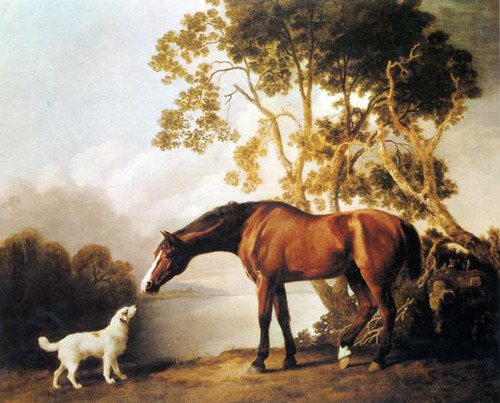
[Paintings by George Stubbs.]


Thursday, February 9, 2012

Compassion: Yet Another Endangered Species?

I’ve been reading Ian Parker’s “The Story of a Suicide: Two College Roommates, a Webcam, and a Tragedy,” a New Yorker article about the Rutgers freshman who jumped to his death from the George Washington Bridge, leading strangers to jump to conclusions about his motivation. The author includes numerous e-mails and text messages that the players in this drama exchanged, and I was struck again and again by a common theme in their banter: compassion. Or, rather, a lack of it.

I realize these exchanges were private and written in techno-haste by kids who easily fall prey to the rhythm of peer-bashing—us vs. them. But words impart meaning and if used repeatedly, become a kind of truth. Homosexuals weren’t their only target. The kids expressed disdain for violinists, computer illiterates, people of inferior intelligence, people who don’t have Gmail addresses, and, most especially, poor people.

Poor people?

I thought I knew what I was up against in my mission to generate compassion for animals from the general population. But this New Yorker article indicated a societal mindset foreign to me.

As I related my concern to my husband, he found “What, Me Care? Young Are Less Empathetic” by Jamil Zaki. It’s a summary in Scientific American of long-term studies conducted on empathy in humans—how we apply it and how we think about it. In the U.S. college population, empathy has been on the decline in the last decade.

After watching the Super Bowl ads and halftime show this past weekend, I can understand why. It seems as if harshness and snarkiness and loudness are easy to come by in the media; for softness and kindness and quiet, we have to actively search for examples. All too often, most of us take whatever comes to us. I thought this indicated that our emotional world is out of balance with our multimedia world, especially for younger generations. For compassion to gain importance, we simply have to try harder to achieve equilibrium.

Then I read the comments to the Scientific American article. Here’s one that stands out:

“Perhaps low empathy levels could be improved if people were given the time and space to find each other interesting. … If it were somehow necessary for people to depend on the kindness of strangers, they might find reasons to care about them.”

Ah, it all makes sense now. If poor people could just be more interesting, they might rouse compassion from others. Poor people (like exploited animals) vie for our attention in the same media muddle as do displays of glamour, sexuality, affluence, athleticism, and trendiness. Is this a level playing field? How can we make society’s invisible more interesting?

I was about to give up on humans until I read this in Poetry magazine:

“If I can only be horrified by my species, then I will have to kill myself. If I find others recognizable, I guess I will continue. It’s as simple as that.”
Fanny Howe

I guess it is as simple as that. I must do what I can as I can. I urge you to do the same.

Sidenote
One difference between empathic individuals (children and adults) and
those with little compassion: Those who read more fiction have more empathy.

[Pics from top to bottom from Dog Files, Have Dog Blog Will Travel, and Dog Eat Dogma.]

Tuesday, January 24, 2012

Sociopaths and Sandhill Cranes

Sorting the Defective Brains from the Poorly Operated Ones

One of the horse bloggers I check in with periodically is starting an online reading group: WHOAprah Whinny’s Book Club. The blogger is pushing for the inaugural book to be The Sociopath Next Door by Martha Stout. Her reasoning: She wants to understand horse abusers.

After scanning the reader reviews on Amazon.com, I may actually read Stout’s book. Not only does she identify the conscienceless and describe typical interactions we may have with them, she instructs readers in how to navigate these interactions.

Wish the book had been around in the previous century. Years ago my husband and I had only M. Scott Peck’s People of the Lie: The Hope For Healing Human Evil to turn to. We were trying to understand the odd behavior of a theatre director. The book described this guy to a T and labeled him “evil.” Though it was a relief to read about our problem, it didn’t help us handle our problem. I suspect The Sociopath Next Door could also have helped us deal with Mr. Slimy, our nasty landlord in the Windy City (or any of the other psycho landlords we cycled through there). As for the horse blogger’s desire to understand horse abusers through this book, though, I’m not sure how enlightening it will be.

The Sociopath Next Door examines only one end of the spectrum—the folks whose brains are clearly physiologically without conscience. What the book probably doesn’t explain are the motivations driving the millions of other a _ _ holes out there who simply aren’t engaging their consciences. The folks who capably exhibit sympathy or empathy or compassion in some situations yet not in others.

A character in The Last Detective television series said: “Really decent people have a tendency to bring out the worst in the rest of us.” Could it really be that simple? Sometimes it is. I’ve seen it played out in the workplace.

The only way in which I can relate to this phenomenon is when one element of my personality is brought front and center by some opposing personality. For instance, an extroverted, authoritative personality (i.e., “bossy”) will meet a mute me; a timid, uncertain personality will be drawn out by an encouraging, courageous me. Both are elements of my personality, but they usually act in harmony with all the other elements. They don’t go solo except when provoked under certain circumstances. When this happens, I feel as if I’ve been taken hostage. Maybe it’s the same for some people when they run up against goodness. They can’t help it: Their antigoodness element gets switched into high gear and before they know it, they’ve said or done something despicable.

In the case of bullies, perceived inferiority, lack of intelligence, or weakness may trigger their nasty behavior. Unfortunately, animals fall into all three of those categories (not in reality; just in perception). And bullies aren’t the only ones classifying animals this way.

I’ve been watching Buck, the documentary film about Buck Brannaman’s gentle approach to starting and training horses. Brannaman endured years of physical and emotional abuse at the hands of his father, and so seems to be able to understand the hypersensitive nature of horses. Yet, in one segment of the film, he treats cattle as if they were simply obstinate moving objects.* Which is pretty much how most animals deemed “livestock” get treated. Even horses fall into this category in some folks’ minds (see “Do Horses Live in the Moment” on Grey Horse Matters). It bothers me that Brannaman, who has so much empathy for horses, can traumatize calves and their mothers without a second thought.

I’m not saying Brannaman abuses the cattle. But he doesn’t offer them the same respect he shows for horses. Not all animals are equal.

“If only there were evil people somewhere insidiously committing evil deeds and it were necessary only to separate them from the rest of us and destroy them. But the line dividing good and evil cuts through the heart of every human being. And who is willing to destroy a piece of his own heart?”
—Alexander Solzhenitsyn


I don’t believe all animal abusers are completely without conscience. If that were true, then the number of sociopaths in our midst would be much higher than the 1% to 5% range researchers currently report. However, I do believe these people are deeply flawed. At least, their thinking is.

This subject has been top of mind for me recently because I’ve been invited to attend Kentucky’s upcoming Humane Lobby Day. Animal welfare advocates from all counties gather in the state capital and meet with politicians to press for change. Not long ago, the Bluegrass State fell dead last in the Humane Society’s state rankings on animal welfare. The low score was achieved by having few laws on the books to prosecute animal abusers in a meaningful way.

Certainly, laws are important in this battle, but once you have a law in place, you have to enforce it. And more than that (and this is the crux of the matter), people (residents, cops, lawyers, judges, etc.) have to comprehend the laws and understand the necessity for the laws, which requires a certain mindset regarding animals. While my peers push for new and stronger laws to be enacted, I will be pushing for this mindset to be instilled in Kentuckians. I’ve come to this decision, oddly enough, because of Sandhill Cranes…
to be continued

* I still recommend the film. The methods Brannaman uses with horses and the results he achieves are worth emulating.

[Top pic is Abbie, rescued from a “horse breeder” by Catskill Animal Sanctuary.]

Friday, October 2, 2009

Hitting the PC Ceiling

I started reading Betsy Burton's The King's English, her memoir on opening an independent bookstore in Utah. She and her business partner struggled over the perfect name for their start-up and finally came to a happy agreement over "The King's English."

It was the mid-'70s and not surprising when a couple of feminists walked through the door of the shop. And being a feminist herself, Burton didn't expect to be taken to task by the women.

"Why not The Queen's English?" they asked.

Burton responded with grace and turned the troublemakers into customers. The scenario reminds me of a hiring incident I once bumbled through.

In the mid-'90s, I began my tenure as managing editor of a stable of newsletters. The editorial department was a rowdy generational mix of writers and word snobs who ridiculed me for my political correctness (e.g., I insisted on using a plural in place of "he/him" so as to include both genders). Slowly, they came around.

But then one day, even my sense of empathy was put to the test.

I was interviewing a candidate for a proofreader position. He was smart, had the right credentials, but seemed a bit too smug for my liking. And then it happened. I used the phrase "Copy Nazi" with a smile and his dander went up.

As I listened, mouth agape, this fellow reprimanded me for being so insensitive. Turns out his great-grandfather was an SS official of some sort and he didn't appreciate my little witticism.

Ouch! The PC girl wasn't PC enough, apparently. As serious as colleagues saw me, I had nothing on this guy. I knew he wouldn't make it in the company culture and decided on the spot not to hire him. But he's stayed with me—I think to remind me not to push anything too far.

Sunday, August 30, 2009

A Cry in the Alley

"All I've had is Misery—for years and years and years and years and years and years and years."

She wailed this into the cellphone that may or may not be in the hand cupped to her ear. She's dressed well enough from what I can tell from my third-floor window, yet her shopping cart holds the telltale signs of a homeless life.

Just a moment ago she had shouted a few expletives that drove me from my much-needed sleep to my back porch. Country folk have roosters; in my neighborhood, we have the cries of the distressed or the demented or the drunk reverberating off the walls of buildings. I always have to decide which it is so I know whether the police should get involved. (Not sure why I think like that. The police rarely answer a call on my street.)

You know what people sound like when they sob or scream from someplace deep in the fibers of their souls? When they use every scrap of air and energy to expel whatever demons and sorrows are barnacled there? I don't know how to spell that particular sound, but this middle-aged woman uttered every syllable of every word that way—explosively, plaintively, desperately.

I sounded like that last week in my car. But I was by myself. In a closed container. This woman was on a very public stage expressing her grief.

"I don't like it here," she continued.

None of us would. None of us would want to be in her shoes in that alley in that moment of time. I wish I could hand her a salve for her spirit or relief from her life.

Instead, I'm writing to you—passing on her woes. How should one respond to a cry in the alley? 
Related Posts Plugin for WordPress, Blogger...