Showing posts with label farm animals. Show all posts

Monday, July 16, 2012

Animals as Commodities: Kentucky Redefines “Animals,” “Pain,” and “Welfare”

I’m headed for the state capital tomorrow to hear what the Kentucky Livestock Care Standards Commission is recommending for legislation. If you live in Kentucky, I urge you to join me.

Members of the Commission were appointed by the governor and include a pork farmer, a bovine farmer, a judge, a citizen concerned about food safety, an associate dean from UK’s Ag College, a grocer, an autoworker who represents sheep and wool producers, a private investor, several veterinarians, and the pièce de résistance—a farm manager from Cal-Maine Foods, the “largest shell egg producer” in the U.S.

This Commission garnered a little publicity last year when the Humane Society of the U.S. accused it of meeting privately instead of publicly (as it’s supposed to). Since then, the Commission has been known to tweak its recommendations via e-mail rather than in public meetings.

Why so much secrecy? Because a few contentious issues are at stake—such as tail-docking and beak-cutting sans anaesthesia or painkillers and confining animals in crates that are too small for the animals to move in. Apparently, the Commission talked at length during the last meeting about whether to include the words pain and welfare in the standards.

According to Kentucky’s State Veterinarian, Robert Stout, the animals at the center of this hubbub are “commodities,” not “companions,” and he hasn’t seen the science yet that proves commodities feel pain. With “advocates” like Stout, Kentucky animals don’t need any more enemies.

However, I believe the Commission needs a language expert on board to help them suss out obfuscations and stick to clear definitions of terms. I also believe some of the Commission members need to retrieve their consciences and try not to view everything through the lens of profitability (read: greed).

For those of you who live in Kentucky, I want to share a conversation I had recently with a Bluegrass veterinarian. She lamented how many out-of-staters regard Kentuckians as ignorant and backward—even out-of-state vets characterize their Kentucky counterparts this way. I had to bite my tongue. You see, it’s people like Robert Stout who aren’t helping your image. So do Kentucky a favor and prove to the rest of the nation that you’re thoughtful and compassionate. Attend the meeting tomorrow to remind the Commission members that they’re accountable for their decisions. Remind them to see beyond the Almighty Dollar.

The 1:00 meeting is scheduled for tomorrow, July 17, at:
Office of the State Veterinarian
100 Fair Oaks Lane, Suite 252
Frankfort, KY 40601

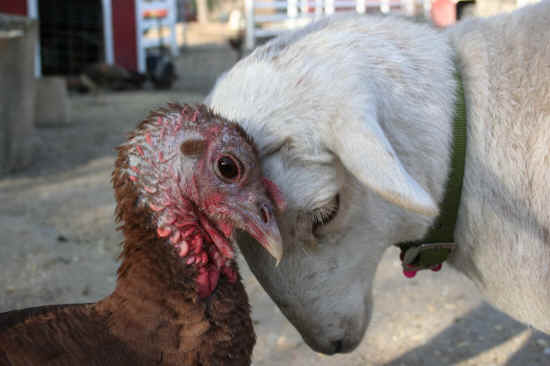
[Photographer unknown.]

Friday, September 23, 2011

Sorrowful News About Barbie


As National Farm Animals Awareness Week draws to a close, so has the life of Barbie.

Barbie lived the better part of her existence at Catskill Animal Sanctuary with her best friend, Rambo the Ram. She started out as a Broiler chicken, yet her lifespan was more than double that of her brethren who are sent to slaughter around 6 weeks of age, their huge mutant bodies already taxing their internal organs. They’re old within the first few months of their lives.

However, free-range chickens whose genetics haven’t been tampered with can live for 35 years.
Barbie was 3-1/2. She was fortunate to have found a home in CAS and to experience air and mobility and friendship.


[Top pic is Barbie. Little Evie of the Flying Ears is from Celtic Farm Animal Sanctuary, which had to close this year from lack of funding; someone adopted Evie. The bottom pics are from the Farm Sanctuary.]

Tuesday, September 20, 2011

Old MacDonald Had A Farm …

E I E I O …

I passed a good deal of my childhood on my grandfather’s Midwestern hobby farms. He had the usual assortment of critters: horses, cows, pigs, geese, ducks, chickens, and sheep. Snakes, turtles, deer, quail, and pheasants populated the woodlands and fields surrounding the farm. There was always something to see and do, and I had a million questions. My grandfather eagerly schooled me in the ways of nature and I hung on every word.

After a typical idyllic afternoon on the farm, my grandfather and I drove his Scout back home where he would prepare our main course for dinner: steak. While he grilled outside, the very young me sat down to write nearby.

“What are you working on?” he asked.

“I’m writing to Congress and the President.”

He chuckled. “What for?”

I explained that I’d read something in my Ranger Rick magazine about people killing cows for food. I was furious at grown-ups for their callousness and I intended to stop them through legislation. My grandfather stepped away from his grill.

Poor man. Some adults dread having the sex talk with children; others the drugs talk. In my family, it would be any kind of discussion with me that involved the demise of animals.

That’s when I learned that the juicy steaks I’d looked forward to eating had once roamed the farm with the bovine herd I loved. I had no idea.

I put down my pen. I could no longer complain about slaughterhouses since I was as much a murderer. I stepped down from my soapbox.

This moment in my history surfaced because it’s National Farm Animals Awareness Week. Unlike National Chicken Month, this celebration originated with the Humane Society of the United States and promotes the animals themselves rather than the consumption of them.

I’m honoring the occasion by reading The Bond: Our Kinship with Animals, Our Call to Defend Them by Wayne Pacelle. He’s the HSUS President and explains some of the legislation his organization has been working on to change agribusiness. I’ll no doubt reference this book in future posts. For now, I’d prefer to share a short anecdote about the emotions of cows:

“[Rosamund Young] has absolutely no doubt that cows feel all the major emotions that humans do. … “How about surprise?” I asked, remembering that some philosophers claim that animals cannot feel surprise because they cannot anticipate the future. “Well,” she said, “how about this? My Welsh black cow had six black calves, and then one day she produced a pure white calf (she had been mated with a Charolais bull). She came round to our door and stared at us with a look that was easy to read: ‘Are you sure it’s mine?’”
—From
The Pig Who Sang to the Moon: The Emotional World of Farm Animals, by Jeffrey Moussaieff Masson

[Pics of calves from the Farm Sanctuary.]

Friday, December 31, 2010

Know Any Vegetarians? Tell Them About Catskill Animal Sanctuary

My apologies for being out of touch these past few months, but I’m still in the throes of funerals, cleanouts, and Christmas. I’m writing today because of a plea I received from Catskill Animal Sanctuary, an organization I told you about in October. (Remember Rambo?)

Founder Kathy Stevens, who now blogs for the Huffington Post as well as for CAS, was challenged to raise 1.5 million $mackeroo$ for her farm rescues. If she does so by the end of today, that money will be matched by some generous individual.

She’s close, but about $100,000 short.

Now I realize that most Lull readers have little cash in reserve, but maybe you know someone in better financial health who can spare some green for neglected and abused farm ani
mals. Or for the programs Stevens has developed to educate people about agribusiness.

Please spread the word. Let’s help her get that match.

[Pictured are Goosezilla and Babe from CAS.]
Related Posts Plugin for WordPress, Blogger...