Tuesday, January 24, 2012


Technical difficulties at Blogger today. Hope to post again soon, Blogger willing.

[If you know the artist of this little robot, please let me know.]

Monday, January 23, 2012

A New Soul, An “Aw” Moment

Did you see the news? Rachel Alexandra, who made headlines some years ago in the racing world, gave birth to her first colt yesterday.


[Pic from Stonestreet Farm.]

Saturday, January 21, 2012

You Think You’re Special?


dysfunctional family: any family with more than one person in it”
—Mary Karr

[Art: The Family by Picasso.]

Thursday, January 19, 2012

A Moment Suspended


After seeing the autumnal splendors from Natural Bridge last year, we met this little fellow (gal?) on the path back to our car. He appeared to be teetering between life and the next life, so we moved him closer to the woods for a calmer transition.


“Uh-oh. What are you about to do?”

But not before we took some photos of him, which, in spite of his condition, he managed to blur or escape the frame each time. I regret taking advantage of him that way, though I like to think that we gave him a better end than getting stepped on by other tourists.


“Knock it off with that picture-snappin’, boyo. I mean it!”

Watching him—his vivid green, his leafy shape, his tense determination—was a near-perfect end to our afternoon.

“To the attentive eye, each moment of the year has its own beauty, and in the same field, it beholds, every hour, a picture which was never seen before, and which shall never be seen again.”
— Ralph Waldo Emerson

Monday, January 16, 2012

Merry Monday


“Someone spiked my coffee with optimism this morning and I spat it right out.”

—Larry Carlat


This made me laugh, but I imagine some of you out there are facing your workweek with just this sentiment. Shoulder on, readers…

[Art by Eric Carle.]

WordGazing: Finally, Justice Will Be Served

I WAS A DRUM MAJOR FOR JUSTICE
PEACE AND RIGHTEOUSNESS

The text above is on the Martin Luther King Jr. memorial in D.C. Not only is it carved without punctuation, it’s also paraphrased.

Yup. Not really a quote. And not even the gist of the original utterance, which is:

“Yes, if you want to say that I was a drum major, say that I was a drum major for justice; say that I was a drum major for peace; I was a drum major for righteousness. And all of the other shallow things will not matter. I won’t have any money to leave behind. I won’t have the fine and luxurious things of life to leave behind. But I just want to leave a committed life behind. And that’s all I want to say.”

What’s more, when you think about the abundance of material the highly quotable Dr. King provided us, why in the world was this chosen in the first place?

The truncation was a “design change” according to Ed Jackson Jr., the executive architect. He ran it by the oversight body, the U.S. Commission of Fine Arts, and they didn’t have a problem with it. Neither did the Council of Historians.

Shame, shame, shame. If space was really an issue, then the solution was not to abbreviate but to choose different material. A quote that’s paraphrased isn’t a quote. Period. PERIOD, screams the editor in me.

I don’t expect architects to understand the problem with this kind of language bastardization, but I certainly expected more from the historians who approved it.

The good news today is that the stone-chiseled text is going to be fixed. Not sure how, but I’m glad someone in D.C. finally saw the light.

Here’s a King quote that speaks to me, that reminds me how to live my life:

“Our lives begin to end the day we become silent about things that matter.”

Sunday, January 15, 2012

What We Cherish

Just as Jane Goodall continues caring for Jubilee, I continue to keep Icky by my side.

I’ve no idea how he got his name and no one in my family remembers either. He entered my life shortly after my birth, while I was still in the hospital, and has stayed with me ever since. He’s been cuddled, fought over, lost, found, washed, and stepped on; he’s gone swimming, swinging, camping, and travelling; he’s been read to and cried on, squeezed and loved.

Last week my husband operated on Icky, who had become profoundly impaired. I’m sorry I don’t have a “BEFORE” photo to share with you (although Icky probably wouldn’t have appreciated that). Imagine a wilted mound of terry cloth with felt facial features.

NOW look at him! Icky has never been so solid. It’s the first time he’s been able to sit up on his own. With new stuffing and a clean playsuit (he didn’t come clothed originally, but a good wardrobe was always paramount in my family so I kept him in doll clothes), he’s ready for the next segment of our journey together.

Thank you, dear husband, for reviving my first animal.

And thank you, Icky, for your perseverance and patience.

Saturday, January 14, 2012

Book Report: Seeking Good Cheer (Or, Barring That, Hope)

I finished the sheep detective book last night. Hated closing the cover on the little flock. They were quite charming.

Started Jane Goodall’s Reason for Hope: A Spiritual Journey. Seemed like a sound choice for someone in need of uplifting reading material.

Goodall’s concern for nature and animals was evident when she was but a baby. Her mother often told a story about the night she stepped up to 18-month-old Jane’s bed to wish her sweet dreams and found two handfuls of earthworms wriggling beside her daughter.

“Jane,” she cautioned, “if you keep them here they’ll die. They need the earth.”

Jane immediately scooped up her little friends and, with her mother’s assistance, returned them to their home in the garden.

I think I’m going to like Jane…

[That’s 18-month-old Jane in the photograph, on the beach with Jubilee—a stuffed animal commemorating the first chimp born at the London Zoo. Goodall still has Jubilee.]

Friday, January 13, 2012

A Friday the 13th Tale: Crossing the Line

This tiny tale has no spook factor except, perhaps, for its starring black feline. (And truth be told, when you stepped close to her, you could see she was more auburn than black.)

A purebred Sable Burmese, she entered my husband’s life after being abandoned by a second set of human “guardians.” When my husband’s life expanded to include me and a couple of other cats, her indignation rang loud and clear. She kept to herself and was easily annoyed by everyone around her. She had a range of strident, nails-on-a-blackboard vocalizations that we all dreaded and, as she aged, she added barking to this repertoire.

One evening we were watching television. The two younger cats were amusing themselves elsewhere and, in a rare moment, the Burmese deigned to join us. We gave her a treat—the last bit of yogurt on a spoon. Placing the spoon in a bowl, we set the treat on the floor for her.

Heaven! She was all over that spoon! We’d made her one very happy kitty.

But then she made such a racket clanging the spoon against the bowl that we couldn’t hear the television. As we turned to watch her, she stopped. In the quiet, she uttered one of her signature “Hrrmphs” and next, as if it was so-ooo-oo beneath her, she picked up the spoon with her right front paw, brought it to her tiny mouth, and licked the last bit off—the bit that had resisted her during all that noise.

My husband and I looked at one another, then back at the cat. She returned the spoon to the bowl and, satisfied, walked away.

We witnessed it only once, but it was enough to convince us that the Burmese was capable of anything—speaking five languages, roller-skating, leading Special Ops. Of course, these are mere Human activities and she crossed the line only when she deemed it absolutely necessary.

Animals are a great deal smarter than humans give them credit for. Just ask the Burmese. But don’t expect an answer.

Sunday, January 8, 2012

The “Not What It Seems” Department


For those whose New Year’s Resolutions include slimming down, here’s Sleep Talkin’ Man’s take on the poundage situation:

“I’m not fat. No. It’s just my awesomeness swelling up inside me.”

[Art by Fernando Botero.]

Friday, January 6, 2012

Holding Gloom and Doom at Bay

“Hey, Poky,” greeted my husband the other morning as he inched his way into our living room. I’m not sure why he called me Poky. A reference to Poky Little Puppy perhaps?

“That’s just what I’m reading about!” I said a little too enthusiastically, The Omnivore’s Dilemma open in my lap. “The Poky Feedlot is…”

He didn’t let me finish because he assumed the word feedlot led only to tragic details. “Maybe it’s time for you to read something cheerier.”

What? Oh, well, I suppose feedlots are not the best topic to start the day with. And I suppose bringing up 1950s American civil rights issues the night before as we got into bed was also a poor timing choice. (I’d started reading Nikki Finney’s Head Off & Split.)

My husband continued his argument though he’d already made his point. I’d started a similar debate in my head long before that morning. Much of what I read upsets me, then upsets him whenever I share what I’ve learned. If I don’t share it, then my somber mood says what I haven’t vocalized. To reinstate calm in our house, I needed to rethink my reading list.

So I’m wiping the slate clean. I’m putting aside the remaining books of my “Current Reading Lineup” and starting over. I’ll get to those back-burner books one day (especially Pollan’s work, which I highly recommend). For now, I’ll avoid the library and pull books from my own inventory.

My first choice? Three Bags Full: A Sheep Detective Story by Leonie Swann. Yes, you read that right. I’m still reading about animals. But (and it’s a BIG BUT) the sheep are the protagonists of a fictional whodunit laced with humor and woolly-eyed insights about our culture. All the wooled ones know of the world they gleaned from the stories their shepherd-cum-murder-victim read to them. It’s a refreshingly inventive and fast-paced read. For those of you who have sheep, I would guess this is even funnier, and might prompt you to reconsider some of your flock’s behavior.
Until tomorrow, I’ll be in Ireland with Miss Maple (a very intelligent ewe), Mopple (who has an excellent memory, but an insatiable appetite), and Othello (the mysterious black ram, of course)—my first attempt to bolster cheer and optimism in my home.

[Art by Thomas Sidney Cooper.]

Wednesday, January 4, 2012

What’s Your New Year’s Resolution?

If you’re short on goals for 2012, here’s one to add to your list:

“Read, every day, something no one else is reading. Think, every day, something no one else is thinking. Do, every day, something no one else would be silly enough to do. It is bad for the mind to continually be part of unanimity.”
—Christopher Morley


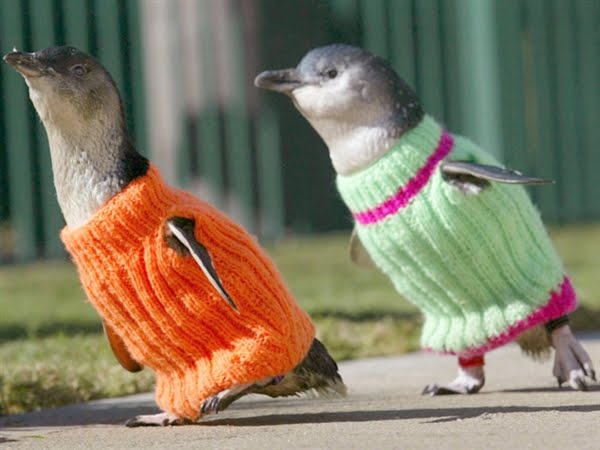
[Blue Penguins after surviving an oil spill last year, now enjoying their new volunteer-made sweaters. Photo by Toby Zerna/Newspix via Rex USA file.]

Monday, January 2, 2012

Love in Shades of Blue

A month ago I got a call from a friend—the kind of call we dread receiving, the kind of call we dread having to make. I knew from B.’s voice that something was wrong. And then it tumbled out: His cherished buddy—his first dog—had reached the end of his Earthbound days. They parted physical ways with the assistance of a veterinarian’s needle.

I felt B.’s pain. Not just because I could relate, but because I’d witnessed the profound changes the canine brought to B.’s life.

I remember the first day I saw them together. B. had just adopted Roark from a rescue group (the same one our pooch came from). They were standing together in front of a neighborhood pet-supplies shop, turning the heads of drivers and passersby. In an area glutted by Retrievers and Labs, a stylish man with a sleek blue Weimaraner becomes a spectacle. B. was over-the-top happy with the creature at leash’s end. This happiness alone was an entirely new dimension of B.’s personality. Well, perhaps not new, but previously concealed most of the time. Roark had managed, in only a few days, to beeline straight to B.’s heart and make public B.’s range of emotional depth. They were bonded.

Then came trouble. For, of course, Life is a bloody seesaw and won’t let you experience long-awaited joy without soon balancing that out with a burst of bad news. In Roark’s case, it was a wonky heart and kidneys. B. saw more vet specialists and emergency teams in his first months with his first pooch than some of us see in our dogs’ lifetimes.

The rescue group stepped in and defrayed the costs (financial, not emotional) of the healthcare roller-coaster Roark was riding. In the wings, B.’s friends and family held their collective breath. Would the dog make it through? If not, would B. make it through?

When both made it through, there was a collective sigh of relief. Death had not only released the dog from Its grip, but had also left Roark and B. even more devoted to one another.

B. was no longer alone. He became part of a six-legged man-beast hybrid, half of an inseparable pair. They walked together, lazed around together, travelled together, ate together, snuggled together.

B.’s fashion priorities shifted. In the B.D. era (Before the Dog), my friend never stepped beyond his threshold without being tastefully dressed. And he could get snarky about people who did otherwise. But once B. accepted his new status as dog steward, along came “dog clothes.” Stylish still, but not always so perfect.

B. started to rethink his life’s purpose. He gave up everything in the Windy City and ventured West—with Roark at his side—in search of new terrain and soul-fulfilling work. They camped. They met interesting people. They smelled the unusual, saw the magnificent. They had a truly great adventure together. And on the road, B. learned more about himself and realized he belonged—at least for a while—back in the Heartland. The answer was not in the West. And so they journeyed, from Oz to home, together.

B. and Roark lived with us for a bit until their new apartment was available. We were happy to have a dog roaming the rooms again, and B. was a great help to us as we prepared to move to the Bluegrass. I took Roark for walks, but mostly I just watched him, for he made it quite clear that his affections were meant only for B. When B. left the apartment for any reason, Roark cried and pined inconsolably at the door.

After we moved to Kentucky, B. and Roark moved to the East Coast temporarily. B. had been accepted into a degree program that would springboard his life’s calling. We were thrilled for him. At last, with Roark at his side, Life was falling into place for him.

Three months later, the seesaw shifted. Roark’s body started turning against them both, his impaired organs becoming markedly wonkier. Filled with toxins, the poor dog could no longer control his actions, and knew it. Soon, according to the vet, Roark’s brain would also be affected. The inseparable pair knew this couldn’t be allowed to happen. The inseparable pair knew they had to let go of one another.

B. spent Thanksgiving weekend snuggling with his best friend, giving Roark his undivided attention. It would be their last weekend together.

When B. and I talked, he mentioned that Roark had been with him for only 4.5 years. I couldn’t believe it. Obviously, I’d lost track of time, but they were so much a part of each other it seemed they’d been together a lifetime.

Whatever the time they had together, I believe B. and Roark spent it “ankle-deep in Heaven.” And it just doesn’t get any better than that.


À bientôt, Master Roark…

Sunday, January 1, 2012

Congratulations!


If you’re reading this, then you made it through 2011. And that’s something for some of us.

I’m glad you’re here and I hope you keep coming back.

Saturday, December 31, 2011

It’s Headed This Way

Said my dental hygienist yesterday, “I sure hope 2012 is a better year than this one was.”

“Me, too,” I sputtered. Although I’ve said that for the last six years. Each year has brought me new and unexpected challenges (which is a nice way of saying pain and trouble).

For the record, I don’t buy into that “What doesn’t kill you makes you stronger” crap. Nor do I subscribe to the “You’re given only as many trials as you can handle” baloney.

One of my favorite lines in Steven Kotler’s A Small Furry Prayer is: “I had come into adulthood equipped with the essentially romantic delusion that life would get easier.”

Amen to that, Steven. I operated under the same delusion, though in retrospect, I realize my grandmother tried to feed me the truth early on. Her version of Cinderella had the wannabe princess end up marrying a used-car salesman. I missed her point.

A similar delusion has us believing every year that the NEW year will be different and better than the last—maybe even GREAT! But I’ve wised up. I refuse even to pretend that 2012 will bring happiness and improved economies and world peace.

However, I will agree that 2012 will be different. At least it will be for me. The New Year may throw me whatever it wants—natural disasters, death, illness, you name it. I’ll be ready for it. This year I insist on being the victor, on being in control. I plan to meet each challenge of 2012 with new strength (both physical and emotional) and resolve. If I can’t catch all the curveballs thrown at me, I will at least duck their trajectories.

But for you, Dear Reader? May the New Year rise to your highest expectations and fulfill your every dream…

My Year of Reading Aimlessly

“I do not want to be a book worm. If its book is taken away from it, the little blind head is raised; it wags, hovers, terribly uneasy, in a void—until it begins to burrow again.”
—Katherine Mansfield

For the past year, reading has been a salve for my grief and a substitute for exploring the world beyond my apartment (doctor’s orders to stay off my feet). I’m not alone in turning to books for spiritual sustenance and guidance. Nina Sankovitch read a book a day a few years ago to comprehend her sister’s death, then turned the 365 project into a best-selling book—Tolstoy and the Purple Chair: My Year of Magical Reading.

Unlike Sankovitch, I’ve no best-selling book as a result of my year of reading. And I certainly didn’t match the pace and quantity of her reading. I had no deadline and no specific goal in mind.

Yet I feel changed by my bookwormishness. My grief has lightened, I’ve learned loads, I’ve discovered (or rediscovered) some critical aspects of my nature, and I feel not quite whole but substantial enough to serve the greater good in some way. Though reading didn’t heal me physically (I’m still supposed to stay off my feet), it accomplished remarkable emotional and spiritual feats.

Like Katherine Mansfield, I need to be more than a bookworm now. Venturing forward, my reading will be specifically purposeful: to strengthen and improve my physical well-being, and to advance an animal-related education project for which I’ve volunteered my time. I’ll miss making random book picks at the library, but I look forward to reading for a cause.

Correction: I (almost) ALWAYS look forward to reading. Period. Don’t you?

[Art by Ramón Casas.]

Wednesday, December 28, 2011

A Bounty of Bad Choices

I’ve started a project that has me reading books for youngsters, specifically books involving companion animals. While scanning the library shelves last week for dog haikus, I tripped over a Lemony Snicket tome and was curious about what lessons the popular author was instilling in today’s youth.

The content is silly sometimes, sarcastic other times. Readers need to be intelligent enough to know the difference. But some messages in Horseradish: Bitter Truths You Can’t Avoid contain both humor and wisdom, as does this passage on decision-making:

“Deciding on the right thing to do in a situation is a bit like deciding on the right thing to wear to a party. It is easy to decide on what is wrong to wear to a party, such as deep-sea diving equipment or a pair of large pillows, but deciding what is right is much trickier. The truth is that you can never be sure if you have decided on the right thing until the party is over, and by then it is too late to go back and change your mind, which is why the world is filled with people doing terrible things and wearing ugly clothing.”

Wish I’d understood this a LONG time ago…

Saturday, December 24, 2011

It’s Beginning to Look a Lot Like Christmas…

Whew! I didn’t find a tree, but I purchased a 99¢ poinsettia and a wreath of mixed evergreens from the Blue Ridge Mountains, which I took apart to fashion into several holiday arrangements. Instead of a month of Christmas in our home, we’ll have it for a few days.

When my father was a child, Christmas decorations didn’t come out until Christmas Eve. His mother would take him to a church service in the evening. When they returned home, my father would wonder at the swiftness and thoroughness of Saint Nicholas—who had visited during the church outing. The Bearded One left behind an ornamented tree complete with presents beneath it.

I guess that by waiting until Christmas Eve to start celebrating, I’m carrying on (sort of) a family tradition of old.

Tree Shopping. Again.

We still don’t have a tree. In fact, there’s little in our apartment that tips you off to the season except the stack (somewhat tree-shaped) of boxes—both the cardboard and gift-wrapped variety—near the door.

I’ve been to several tree-selling stands. Stopped at one just this past Wednesday. But, as usual, couldn’t find anything I wanted (read: that was affordable).

However, my desire for a tree swiftly exited when I turned a corner and saw this:


How cute is he? He was part of a nativity scene and far more interested in his food than in making my acquaintance. Okay by me. He made the trip worthwhile.

Now I’m off again in pursuit of a tree. Or a branch. I’m feeling lucky…

Friday, December 23, 2011

You Can’t Always Get What You Want

That old Rolling Stone song is true. The question is, How will you respond?

When 15-year-old Regina Mayer was told she couldn’t have a horse, she took the road less travelled…


[Story and photo from Horse Connection magazine.]

Wednesday, December 21, 2011

Tired of the usual Christmas film fare?

Most of us have a favorite Christmas film classic we have to watch each year—Holiday, Miracle on 34th Street, A Christmas Carol (my husband is partial to the 1951 version with Alastair Sim), It’s A Wonderful Life.

My list is influenced by the fact that A) I’ve never had cable or satellite service, B) Every place I’ve lived has had poor television reception, and C) I’ve not seen many other Christmas movies. Until this week.


Double-click on the video for full view.

Our public station here broadcast an old black-and-white film I’d never heard of: The Great Rupert. It features Jimmy Durante and a philanthropic vaudevillian dancing squirrel. The film (now in the public domain) captures an era not unlike the one we’re currently in—people losing their life savings, old industries giving way to new ones, families struggling to make ends meet. The difference is Rupert, the squirrel.

I’m not sure The Great Rupert will make it onto my perennial must-see list, but it held my interest from an historical perspective. It’s worth watching just to see the filmmaking (i.e., the squirrel-making) of 1950. Plus it’s sweet and nonviolent and stars an animal. All good.

Tuesday, December 20, 2011

Start a Christmas Tradition à la Tolkien

After dropping off books at the library this week, I scanned the titles in the holiday display. Naturally, one called out to me and I couldn’t ignore it. I took home J. R. R. Tolkien’s Letters from Father Christmas.

You don’t have to be part of the Tolkien cult to enjoy this book. It’s a collection of letters and illustrations (and thereby characters and fonts) Tolkien created and sent to his children each Christmas season from 1920 to 1942—letters his wee ones understood to have been written by Father Christmas (or by his elves or his executive assistant, Polar Bear).

F. C. seems a tad cranky to me so far in my reading. Nonetheless, I can imagine what it must feel like to be a kid writing to Saint Nicholas each year, knowing that he will soon respond.

If you have small children or grandchildren, this could be a delightful family tradition to start. Check out the book for ideas, then adapt these to your own writing style and to the Father Christmas you want your progeny to admire.

Monday, December 19, 2011

Heaven on My Mind: Never Can Say Goodbye

Heaven’s been weighing on my mind, but I’ve had a hard time envisioning it.


“Every living thing dies. There’s no stopping it.”
—the opening paragraph of Unsaid, by Neil Abramson

As I posted earlier on Lull, my reading these last few months has been full of heartbreak and partings—people from dogs, horses from people, goats from turkeys, geese from cows. There’s no end to these losses.

I grew attached to the animals I read about on blogs and in books and when they passed into the Great Beyond, my thoughts followed them. I was reluctant to let go.

I take some solace in imagining an idyllic Afterlife where once-Earth-dead creatures now frolic (or graze or float or whatever they desire) and live beyond their psychological and physical constraints.

When I finished reading The Eighty-Dollar Champion: Snowman, the Horse that Inspired a Nation, I kept thinking about the sweetness and patience Snowman had extended to everyone. He had a good life back in the day, but I wondered what his life was now. Surely his story continues.

I e-mailed a friend to share my thoughts about the book (which she had also read) and said I hoped Snowman had found his way to Just-A-Bob, our favorite character in Jane Smiley’s Horse Heaven.

I e-mailed again after realizing my remarks had populated Paradise with fictional creations as well as the blood-and-bones variety. My friend, ever gracious about my many blunders, wrote back to say that of course our fictional favorites reside in the Afterlife. What’s more, fictional places are part of the landscape there (think environments devised by Tolkien and Lewis).

Fictional places? Wow! My friend had just exponentially expanded Paradise for me. I started rewinding my memories of all the books I’d read and all the films I’d seen. It made me dizzy.

“I have always imagined that paradise will be kind of a library.”
—Jorges Luis Borges

Playwright Eugene O’Neill imagines Heaven for us in “The Last Will and Testament of An Extremely Distinguished Dog,” a piece he wrote for his wife in dreaded anticipation of their beloved Dalmatian’s death. It’s written from the perspective of the dog, who describes Paradise as a place “where one is always young and full-bladdered … where each blissful hour is mealtime.”

Like Borges, O’Neill (on behalf of his dog) fashions Heaven in simple and self-serving terms that I can easily understand. It’s whatever you want most—every birthday and twinkling-star wish you ever made all rolled into one. While these are sweet notions, I suspect the truth is a bit more complex.

In his essay “Sick Dog,” environmental activist and writer Rick Bass speaks to the sorrow of loss and posits a different type of Heaven,* one that stokes my imagination and belief:

“[P]erhaps the seams, the laminae, between the various worlds—the past, present, and future, as well as the living and the nonliving—may not be as distinct and clear-cut as we have been taught, or as our somewhat arbitrary clocks and calendars have led us to believe.

“Sometimes—not always, and I think I could even say rarely—but still, sometimes, I perceive that there is a stillness and a wholeness in the world, or in some portion or corner or fragment of the world, for some little place in time, where things just feel so right and huge and powerful and easy that I will have the perhaps blasphemous thought that maybe there are layers of heaven, and that, with our species’ dependence upon visual acuity, we might fixate too much on notions of streets-lined-with-gold as indicator or marker of when a traveler arrives in that place.

“There are definitely moments in time and places in the world where we have each felt the peace and wholeness, the stillness, spoken of in such prophecies and promises. For me it is experienced most often when I am deep in the wilderness, or up on the ridges of mountains, or in the fields and prairies with nothing but field and prairie to the horizon, or when I am simply in the presence of family. In such moments I think very much that the case could be made that we are already ankle-deep in heaven.”

Ahhh. Thank you, Mr. Bass. A picture of Paradise is coming in clearer now.


I think again about the people and animals I’ve met through my reading—their deeply felt bonds, their unfathomable grief over the deaths of their mates. It’s a comfort and a relief to view them through Rick Bass’s lens: to believe that in each relationship, long before the untimely departure of one being, the pair’s Earthly life together was already “ankle-deep in Heaven.” In the future, this is the layer I shall try to commit to memory.

* Paragraphs may not be in original order. Essay is included in the anthology WOOF! Writers on Dogs.

[Painting by Abbott Handerson Thayer and recolored for Lull.]

Saturday, December 17, 2011

“Squirrelly Saturday”: Need a 2012 Calendar?


While shopping for birdseed yesterday, I noticed a calendar that made me do a doubletake.

It was the 2012 Squirrel Stuff Calendar: The Official Field Guide to Undiscovered Squirrels published by Arundale Products. You can purchase the calendar, read the history of these unique squirrels (i.e., how the artist created them), or report your own sighting of an undiscovered squirrel (i.e., give the artist a new idea for the 2013 calendar) by clicking through the links.

These rare critters are almost as cute as my Stubby!

Wednesday, December 14, 2011

Eat Like A Horse

I saw a commercial on television last night that showed one young, vibrant, beautiful person after another enjoying mouthfuls of McDonald’s fare. Clearly, the ad campaign intended to make me crave a Big Mac. But those ad-meisters had nothing on a horse I know.

I met M. (the equine pictured) this fall. He stood on the far side of a paddock until he noticed carrots and apples in my hand. He raced to my side for his share, skipping all pleasantries of introductions. I caved to his brashness and he nearly inhaled the treats.

As his person led him to the barn, I followed. We were almost there when M. suddenly detoured toward a pear tree and claimed his space beneath it.

M.’s person tried to steer him back to the barn, but he wouldn’t budge. He wanted a pear and surveyed the ground for possibilities. As luck would have it, a young rider (who had probably witnessed this scene before) came by and offered the core of the pear she’d just eaten. And then a marvelous bit of theatre unfolded for anyone willing to watch.

M. transformed that fruit scrap into his entire world. All else faded from view as he chomped and chewed and squeezed and sucked and savored that castoff pear as if it were his last meal. As if it were a last meal prepared by restaurateur Paul Kahan and drizzled with rare truffle oil.

M. took care and time to process that small bit of pear, making sure to introduce each individual fiber of it to each of his tastebuds. When some juice escaped his lips, M. tried to catch it with a turn of his muzzle.

Had anyone offered me a pear core at that moment, I would have readily accepted it and tried to re-create M.’s gastronomic passion.

As for that Big Mac I mentioned? Like the actors of the commercial, you’d have to pay me to take a bite.

Sunday, December 11, 2011

Books on the Silver Screen

A dear friend gave me a box of “literary tea”: To each bag is attached a quotation. Here’s one that gave me a chuckle, especially in light of how many 2011 film releases started on the printed page:

“Don’t judge a book by its movie.”


An abbreviated list of films released this year based directly or indirectly on books:

Hugo
Jane Eyre
Mr. Popper’s Penguins

Puss in Boots

Sherlock Holmes: A Game of Shadows
The Adjustment Bureau

The Adventures of Tintin

The Big Year

The Descendants

The Girl with the Dragon Tattoo

The Help

The Thing

The Three Musketeers

War Horse

Water for Elephants

We Bought A Zoo

Saturday, December 10, 2011

Bullish on Christmas

Oh, the humiliation for the pooch pulling the cart. But the pups don’t seem to mind.


[I found this pic online eons ago and no longer have info on it. If you know these dogs or the person who deserves credit for the photo, please let me know.]

Friday, December 9, 2011

Obligations of a Pet at Christmastime

I don’t have a dog. Or a horse or a cat. Not even a turtle or a fish.

When I was a kid sans live companion animals, I collected figurines and stuffed animals to fill the void. Today I read about them.

My current read is Christmas Dogs: A Literary Companion, which opens with a litany of the unfortunate results of mixing dogs with Christmas—white puppies slobbering on the red bows tied ’round their necks that soon turn said white canines into pink ones, dogs who treat the indoor tree as an outdoor one, dogs intent on redecorating the tree.

My pooch never caused a problem at Christmas. She enjoyed herding us when we brought in the tree and when we took it out; she displayed rapt attention and excitement whenever we opened a present intended for her. Otherwise, she didn’t touch or eat or bother a thing. Perfect pooch.

One of our cats, on the other hand, made Christmas difficult every year of her too-short life. She licked and chewed the wrappings: paper and bows. She ripped them open if she hadn’t already eaten them. Not only did she make a mess and endanger her life, she also gave us a peek at our presents and spoiled the surprise I so love about Christmas morning. What’s more, my family’s gifts are as much about presentation as they are about appropriate giving. The paper and bows my imp of a cat destroyed were often handmade, impressive creations.

We were soon trained to keep all presents on tree boughs and atop the mantel, out of her reach. (Yes, I know she could have climbed the tree to reach the gifts hidden in it, but she chose not to for some reason. For that matter, she was such an incredible jumper she could easily have scaled the mantel and shoved every present to the floor. I was grateful in both cases that she exhibited restraint.)

Obviously, our pets’ perceptions of Christmas pageantry often differ from ours. Do you have a holiday memory or anecdote involving your animal companions? Won’t you please share it with Lull readers in the comments section?

I’ll leave you with a poem from one of my favorite children’s book authors.

Christmas Dog
from Falling Up by Shel Silverstein

Tonight’s my first night as a watchdog,

And here it is Christmas Eve.

The children are sleepin’ all cozy upstairs,

While I’m gu
ardin’ the stockin’s and tree.

What’s that now—footsteps on the rooftop?

Could it be a cat or a mouse?

Who’s this down the chimney?

A thief with a beard—
And a big sack for robbin’ the house?

I’m barkin’, I’m growlin’, I’m bitin’ his butt.

He howls and jumps back in his sleigh.

I scare his strange horses, they leap in the air.

I’ve frightened the whole bunch away.


Now the house is all peaceful and quiet again,
The stockin’s are safe as can be.

Won’t the kiddies be glad when they wake up tomorrow

And see how I’ve guarded the tree.


[Dog photo from A Usable Past.]

Tuesday, December 6, 2011

FREE Music for Dogs!

I’m a day late in hearing about this, but I wanted to pass it on to you anyway.

Through A Dog’s Ear is offering a free download each day this week of their specially arranged music for dogs.

Today, for instance, is a Debussy piece. And to top it off, you can play a word contest on behalf of your favorite shelter. If you win, your shelter will receive the Calm Your Canine series of 3 CDs and YOU will win the Holiday Gift Pack of a book and 7 CDs. It’s a GREAT deal!

If your dog, or one you know, gets anxious about anything—thunder, lightning, riding in a car, life in general—check out these CDs and the science behind them. I wish I’d had these CDs when we adopted our pooch—Miss Nervous Nellie, as we so often called her. Then maybe I could have played the piano more often and car rides wouldn’t have been the messy production we all grew to fear.

Do an anxious dog a favor and check out this music while it’s free.

Truth Omitted for an “Aw” Moment

I have a soft spot for Great Danes. And when I read about a Dane (Maddison) who, without being asked and without being trained, took on the responsibility of acting as Guide Dog to her blind friend (Lily), I had to share these photos with you. I wanted to talk about Compassion Footprints—ours and animals’.


However, when I started digging into the story, I found many disturbing details (e.g., the dogs came from a notorious puppy mill breeder—hence, my guess, the blindness, the dogs’ relationship unraveled in their new home). I’ll post links below and you can read the articles yourself—if you want.

This is not the first time I’ve chosen a topic/photo only to have it twist in a distasteful direction. Typically, I’ll find a photo for Lull and then discover that the subject has died (as in the case of Atlas). And, typically, I abandon the topic/photo and create a different post for Lull. When the point of a photo is to lift your spirits, I don’t want the text to bring you down with the backstory.


But no more. From now on, I’m sticking my ostrich head in the sand, thankyouverymuch. Bad backstory or not, for as long as it lasted, the relationship between these two Danes is worth viewing and pondering. Story not required.

Daily Mail on dogs needing a new home

Global Post on dogs finding a new home

Dogs Trust’s FAQ on separation of dogs

Breeder info on the Great Dane Owners Forum

Monday, December 5, 2011

Stories for the Overscheduled

You’ve no time for fiction, you say? Your life’s about to change.

Tomorrow marks the release of 420 Characters, a collection of fictional stories spilling from the mind of acclaimed artist Lou Beach. (If you’re near Los Angeles, you can hear him read excerpts at Book Soup tomorrow night.) No story exceeds 420 characters—the maximum allowed by Facebook for updates, which is where 420 began. Everyone has time to read at least one of these stories this year.

Get the lowdown on the book at NPR or read excerpts in The Paris Review. Now travel to your favorite indie book peddler and help keep the publishing economy moving. Please?

Deck the Halls with … Pumpkins?

I realize Christmas is just around the corner. Retailer music has been reminding me since October. But the tall, strangely narrow pumpkins that grace my window ledges still look so great that I don’t have the heart to remove them.

I paid WAY too much for the pumpkins, and the woman selling them knew it. Then she warmed to me and started telling me about her life.

She raised her daughters the “Country Way”—that is, to be self-sufficient without electricity, plumbing, and running water. When she married, she told her husband she’d do anything for him except cook chicken. She’d had enough of it, for it was her job at the tender age of 6 to kill three chickens every morning. Her uncle—who, with his wife, raised her and her many older brothers—loved to eat chicken. It was served every day for breakfast and supper; the children were spared chicken for lunch because they ate at school.

From this point, the tale turned dark and uncomfortable as it focused on the wrath and unsavory desires of the uncle. While the woman shared the grim details of her hardscrabble upbringing, she insisted on cleaning my pumpkins in bleach water—“They’ll last longer.”

She was right. Those pumpkins look as shiny new and orange as they did the day I bought them. And really, with the woman’s storytelling thrown in, I got a bargain.

Even so, I’ve grown accustomed to their Stan Laurel–like visages outside my windows. I’m thinking a couple of Santa hats atop them could help their transition to the next holiday.

Sunday, December 4, 2011

Mystery Sculptor Strikes Once More

Last month I told you about the paper sculptures left anonymously at various libraries in Edinburgh, Scotland (“Art in Defense of Libraries and Their Treasures”). Each tiny masterpiece was a tribute to the literary arts and the libraries that preserve our heritage.

The Random Acts of Beauty created global buzz and desperate attempts to expose the artist. Yet, in a strange twist to our usual need-to-know-every-dirty-little-factoid culture, readers responding to a newspaper poll said they preferred the artist to remain unknown. For what is Life without a bit of Mystery?


Now the sculptor has returned—perhaps for the last time—leaving behind enough sculptures to total 10 and a letter (pictured above) disclosing two key details: The artist is a woman, and the artworks were her first venture into book-based sculpting.

In my book, that’s impressive: first-time art, creating a mystery, making headlines, ending the story on her terms. What a gift—for all of us.

[See more pics at Central Station and NPR.]

Thursday, December 1, 2011

Stupidity Goes Bipartisan on Horse Slaughter Legislation

Here’s a brief roundup of brilliance from U.S. politicians. I’ll post my rebuttal soon.


“We wanted to allow horse slaughter again in America because of an unanticipated problem with horse neglect and abandonment.”
—Rep. Jack Kingston, R-Georgia


Horse owners in Cole’s district are “pretty unanimous that they want the means to deal with an excess population.”
—Rep. Tom Cole, R-Oklahoma


The federal horse-slaughter ban devastated “an entire sector of animal agriculture for purely sentimental and romantic notions.”

—Rep. Sue Wallis, R-Wyoming

“In Montana, we’ve seen some sad cases of horse abandonment and neglect as owners struggle in this tough economy. Now we can fight to revive the jobs shipped to Canada and Mexico as a result of this ban along with making sure injured and sick horses are not abandoned or subject to inhumane treatment.”
—Sen. Max Baucus, D-Montana

First, Do No Harm: Where Horses and Hormones Intersect

Horses and hormones keep peering at me from my reading. Neil Abramson’s debut novel Unsaid opened with a couple of Premarin foals rescued from slaughter. Random links in blogs have led me to discussions about the safety of hormone replacement therapy, a topic I’m not particularly interested in. But I scanned the comments anyway and was repeatedly disappointed to find that no one ever brings up the HORSES. No one talks about the origins of the “conjugated estrogens” in the drugs they’re taking.
So I think it’s time to talk about it on Lull. Again.

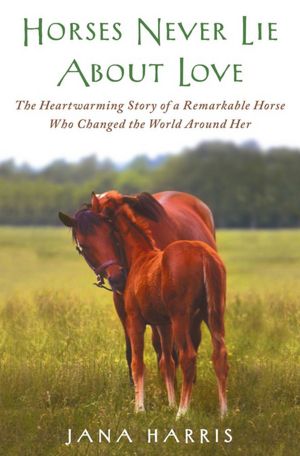
No, I won’t go into the gory details of how mares are tortured and then disposed of once they can no longer be pregnant. Nor will I tax you with tales of foals removed from their mothers shortly after birth and killed on the spot or sent to auction as potential meals for cultures abroad. (Note: You won’t find those italicized words used in any documentation from the pharma or agribusiness industries. The mares are merely commodities, cogs, assets until they’re liabilities; the foals are, as the industries like to call them, “byproducts.”) Instead, I’d like to report on a book I just read: poet Jana Harris’s Horses Never Lie About Love.

I recommend Horses Never Lie About Love to
Anyone obsessed with horses.
Anyone about to buy a horse for the first time.
Anyone thinking about breeding a horse.
There’s a lot to think through before committing to stewardship or sustaining a business and Harris provides a window into the pitfalls of both.

However, I want EVERYONE who is taking, prescribing, or selling any drug that contains hormones from pregnant mares—including Premarin, Prempro, Premphase, Prempak-C, and Aprela (still at the clinical trial stage)—to read this book. I want you to understand what your (likely unintentional) support of this niche of agribusiness and pharma means to the sentient beings exploited in the name of human health.

Horses Never Lie About Love is not an anthropomorphic romp through pastures dotted with mares and foals. It follows the fledgling breeding business of Harris and her husband on The High and Dry Farm and details the numerous challenges and unfortunate realities such an enterprise entails. Harris shares her astute observations about her herd—their idiosyncrasies, their training potential, their communications. She introduces readers to a first-time equine mother who is so enamored of her foal she can’t bear to lose touch with its face long enough for the foal to turn around to nurse; a colt who, desperate for companionship after being ostracized by the herd, befriends a widowed pigeon; a horse who distrusts people if they stand near him, but delights in having them in the saddle on his back; and, of course, the horse’s horse: True Colors—the feral mare who warms to human interaction only when she’s with foal, the mare who proves indispensable to the herd and to Harris (watch the video clip of Harris and True Colors).


Double-click on video for full view.

Harris packages her brief education* about horses and breeding in an engaging memoir. But better than that, she illuminates horses as individuals. This alone makes Horses Never Lie About Love a must-read for anyone connected to the aforementioned drugs. The plight of drug-industry horses is easier to ignore if you also ignore their discrete personalities—if you see them merely as cogs and byproducts. (If you’re new to Lull, make sure you also read “Protect the Sisterhood—No Matter the Species” and visit the links in it.)

Let’s be informed consumers/physicians/salespeople. Once you’ve read about horses thoughtfully cared for as individuals and those enslaved in factories as means to profits, come back to Lull and share your thoughts on the matter. If you know someone who uses, prescribes, or sells Premarin, Prempro, Premphase, Prempak-C, Aprela, or any related drug containing conjugated estrogens, e-mail this post to them. Or give them Horses Never Lie About Love and tell them why you want them to read it. There are plant-based drugs and other alternatives available. Sure, some alternatives require more self-discipline and effort to use, but they won’t hurt any horses. Above all, let’s do no harm…

* This is an informative read but not a how-to. Harris makes mistakes, for which at least one reviewer has taken her to task, forgetting that this is a memoir about events that occurred in a very different era.
Related Posts Plugin for WordPress, Blogger...